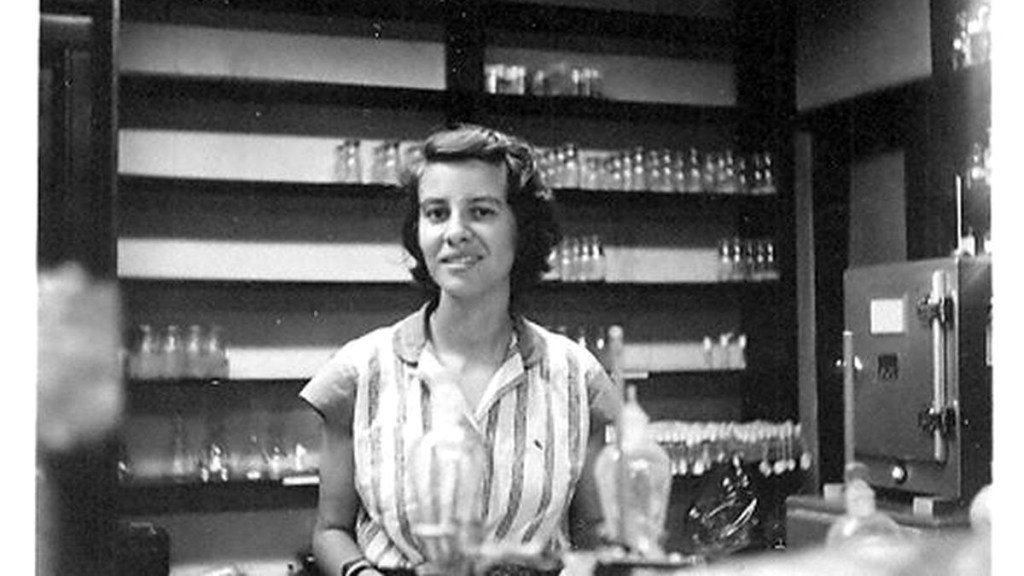
The scene was Stockholm, December 1958. As the Nobel Prize ceremony unfolded in glittering splendour, Esther Lederberg stood beside her husband in a pale evening gown, watching Joshua collect the highest honour in science. Yet the woman who had made many of the discoveries that earned him that prize—who had revolutionised our understanding of bacterial genetics and laid the foundations for modern molecular biology—received not even a mention in his acceptance speech.
This was no oversight. This was the Matilda Effect in action—the systematic erasure of women’s contributions to science, named after activist Matilda Joslyn Gage who first identified this pattern of discrimination. Esther Lederberg’s story exposes the brutal reality of how institutional sexism has robbed science of proper recognition for some of its most groundbreaking discoveries.
The Making of a Pioneer
Born into poverty in the Bronx in 1922, Esther Miriam Zimmer grew up during the Great Depression when meat was a rare luxury and lunch often consisted of bread topped with tomato juice. Her family owned a printing business, but money remained desperately tight. Yet this young woman possessed an intellectual fire that would not be extinguished by circumstance.
While her teachers at Hunter College steered her towards “appropriate” subjects like French literature, Esther chose biochemistry. She graduated from high school at just 15, mastering Hebrew, French, and Spanish. When financial hardship threatened her graduate studies at Stanford, she resorted to eating the legs of frogs used in laboratory dissections rather than abandon her scientific pursuits.
This determination would prove prophetic. At Stanford in 1946, working on her master’s degree in genetics, she met Joshua Lederberg. Five months later, they married. What followed was a scientific partnership that would transform our understanding of life itself—though history would remember only half of that partnership.
Discoveries That Changed Everything
Esther Lederberg’s contributions to science were nothing short of revolutionary. In 1950, while studying E. coli bacteria at the University of Wisconsin, she made a discovery that would become fundamental to molecular biology: lambda bacteriophage. This virus, which she isolated and characterised, exhibited unprecedented behaviour—it could either destroy its bacterial host immediately or lie dormant within the cell’s DNA, integrating seamlessly with the host’s genetic material.
Her discovery of lambda phage opened entirely new avenues of research. Unlike any virus known at the time, lambda demonstrated that genetic material could be transferred between organisms through specialised transduction. This insight proved crucial for understanding gene regulation, DNA recombination, and the basic mechanisms that would later enable genetic engineering. Today, lambda phage remains one of the most widely used tools in molecular biology laboratories worldwide.
But Lederberg’s genius extended beyond discovery to methodology. Frustrated by the inability to efficiently screen bacterial colonies for specific traits, she invented replica plating—a technique that revolutionised microbiology. Drawing inspiration from her father’s printing press, she used sterile velvet cloth to “stamp” bacterial colonies from one petri dish to another, maintaining their spatial arrangement while testing different conditions.
This elegant solution, born from repurposing a makeup compact as a scientific instrument, enabled the Lederbergs to definitively prove that bacterial mutations occur spontaneously rather than in response to environmental pressure. The experiment demolished Lamarckian evolutionary theory once and for all, yet textbooks often credit Joshua alone or “the Lederbergs” rather than acknowledging Esther’s pivotal role.
Her third major contribution—the discovery of the F (fertility) factor—revealed how bacteria exchange genetic material through conjugation. This finding was essential for understanding bacterial reproduction and would later prove crucial for genetic engineering applications.
The Price of Being Mrs Lederberg
Despite these groundbreaking achievements, Esther faced systematic discrimination that would define her entire career. While Joshua became a full professor at 31, she remained an associate investigator despite being three years older and equally productive. When Joshua won the Eli Lilly Award in 1953, he publicly stated that “Esther should have been in on that too”—yet when the Nobel Prize arrived five years later, such acknowledgment was conspicuously absent.
The institutional bias was stark and unforgiving. At scientific conferences, organisers routinely assumed this accomplished researcher was merely a spouse, inviting her to go shopping while the “real scientists” presented their work. Stanford University, when recruiting Joshua as department chair, offered Esther only an untenured research associate position in a different department. The message was clear: her value lay solely in her connection to her famous husband.
The personal cost proved devastating. After Joshua’s Nobel triumph, their marriage deteriorated rapidly. They divorced in 1966, leaving Esther without a laboratory, research funding, or institutional support. Joshua, now a “giant in the field,” would walk past her in the Stanford cafeteria without acknowledgment. The woman who had helped establish the entire field of bacterial genetics found herself professionally orphaned.
Resilience Despite Rejection
Yet Esther Lederberg refused to disappear. Despite never receiving tenure, she founded and directed Stanford’s Plasmid Reference Center in 1976, maintaining and distributing genetic materials that proved essential for researchers worldwide. She organised the registration of the world’s plasmids, transposons, and insertion sequences—unglamorous but crucial work that enabled countless scientific advances.
Her contributions during this period remained vital to the field. She worked on transformation of Salmonella with plasmid DNA and continued advancing understanding of bacterial genetics. When she officially retired in 1985, she continued working at the center through 1986, demonstrating the dedication that had characterised her entire career.
In 1989, at age 67, she found personal happiness with Matthew Simon, an engineer who shared her love of early music and literature. They married in 1993, and together they co-founded the Mid-Peninsula Recorder Orchestra, where Esther found the recognition and respect that had been denied her in science.
The Reckoning That Never Came
Esther Lederberg died in 2006 at Stanford Hospital, aged 83. Her obituaries finally began acknowledging her foundational role in molecular biology, but the recognition came too late. She never received the tenure she deserved, never won the major awards her discoveries warranted, and never saw her name in textbooks alongside the techniques she invented.
The injustice is staggering. Her discovery of lambda phage alone should have earned her lasting recognition—it became the foundation for understanding viral integration, gene regulation, and genetic recombination. Her replica plating technique is used in laboratories worldwide daily. Her identification of the F factor was crucial for understanding bacterial genetics. Yet she remains largely unknown outside scientific circles.
Why Recognition Matters
This is not merely historical injustice—it is a contemporary crisis. When we erase women’s contributions from scientific history, we perpetuate the myth that science is a male domain. Young women entering STEM fields need to see that their predecessors made crucial discoveries, even when those discoveries were later attributed to their male colleagues.
The Esther Lederberg story demands accountability from our institutions. How many other pioneering women have been written out of scientific history? How many current female researchers face similar discrimination? Her legacy challenges us to examine our own practices and ensure that merit, not gender, determines recognition.
Esther Lederberg changed the world through her discoveries in bacterial genetics. She invented techniques still used daily in laboratories across the globe. She laid foundations for genetic engineering, molecular biology, and our modern understanding of gene regulation. That she did so while facing systematic discrimination makes her achievements all the more remarkable—and the scientific community’s failure to properly recognize her all the more shameful.
Science cannot afford to waste talent. It cannot afford to diminish contributions based on gender. Esther Lederberg’s story is not just about one brilliant woman denied her due—it is about the urgent need for justice in how we value and remember scientific achievement.
Bob Lynn | © 2025 Vox Meditantis. All rights reserved.

 Vox Meditantis
Leave a comment