17 Dawson Street
Holbeck, Leeds
12th August, 1886
JOHN TAYLOR & SONS LIMITED
47 Threadneedle Street
London
Gentlemen,
I am in receipt of your communication dated 25th June regarding the death of my husband, William Baldwin, Employee No. 247. Your letter arrived on the 15th July, though the postmark suggests considerable delay in your London offices before dispatch to Yorkshire.
I write not as the grieving widow you no doubt expect, but as a woman who has learned through bitter necessity to conduct business affairs with the same precision my late husband applied to his mining work. Your cold recitation of “outstanding financial matters” and bureaucratic dismissal of a man’s life demands response from someone capable of matching your commercial calculations with equally firm resolve.
Firstly, I dispute entirely the debt you claim against my husband’s estate. William Baldwin possessed twenty years’ experience in Yorkshire mining – skills for which your company actively recruited him with promises of substantial wages and advancement opportunities. Your recruiters, Messrs. Penrose and Barstow, specifically assured him that experienced miners could expect earnings of thirty to forty pounds annually, with accommodation and medical care provided as employment benefits rather than charged expenses.
The “medical expenses” you list at £18.12s.6d represent treatment for conditions directly arising from tropical diseases endemic to your mining operations. Any competent legal analysis would demonstrate that such costs constitute occupational hazards for which the company bears responsibility, not personal debts to be charged against dying employees. Similarly, the “accommodation charges” of £14.8s.2d contradict explicit recruiting promises that housing would be provided without cost to skilled European workers.
I demand immediate return of my husband’s personal effects without condition or charge. These items possess no commercial value to your company but represent irreplaceable mementos of a husband and father whose absence has already cost our family more than your shareholders could comprehend. Any attempt to retain personal possessions pending “settlement of outstanding debt” constitutes theft, plain and simple.
Furthermore, I require detailed accounting of my husband’s actual working conditions, the specific medical treatment provided during his final illness, and the circumstances of his death. Your Mr. Thornton’s dismissive phrase about “tropical fever” provides insufficient information for a widow attempting to understand how a robust Yorkshire miner succumbed to illness whilst under your company’s care.
I have consulted with Mr. Alfred J. Murgatroyd, a solicitor practicing in Leeds, regarding my legal rights in this matter. He advises that recent Parliamentary inquiries into colonial mining conditions have established precedents favourable to families of deceased workers. Should your company persist in treating my husband’s death as a mere bookkeeping exercise, we shall pursue remedies through appropriate legal channels.
My husband died pursuing promises your company made but failed to honour. The least you can do is return his belongings to the family he died trying to provide for, and account honestly for the circumstances that claimed his life.
I await your prompt response and the immediate dispatch of William Baldwin’s personal effects.
I remain,
Mrs. Mary Baldwin
Widow of William Baldwin (Employee No. 247)
WILLIAMS, HARTLEY & ASSOCIATES
SOLICITORS
47 Threadneedle Street, London
2nd September, 1886
Mrs. Mary Baldwin
17 Dawson Street
Holbeck, Leeds
Re: Estate of William Baldwin (Deceased)
Madam,
We acknowledge receipt of your correspondence dated 12th August, which has been forwarded by our client, John Taylor & Sons Limited.
After consultation with our client’s Kolar operations, we are authorised to offer settlement of this matter through payment of five pounds (£5) in full and final settlement of all claims arising from your late husband’s employment. This sum represents an ex gratia payment made without admission of liability.
In addition, arrangements have been made for the return of the deceased’s personal effects, transportation costs to be borne by the company as a gesture of goodwill.
This offer remains open for acceptance until 30th September 1886. Failure to respond within this timeframe will result in withdrawal of all considerations.
Yours faithfully,
H.R. Williams
Senior Partner
Williams, Hartley & Associates
17 Dawson Street, Holbeck
28th October, 1886
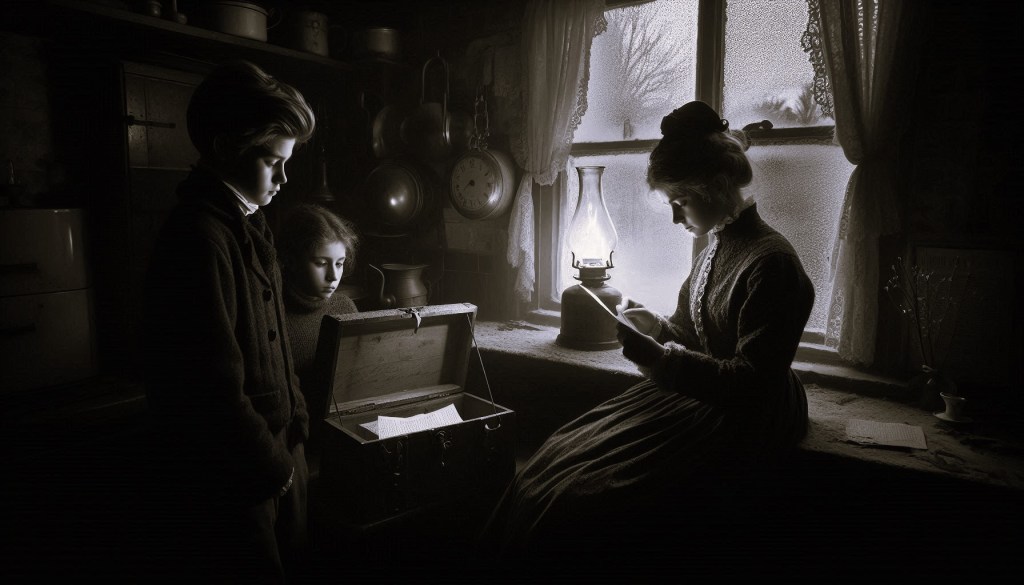
Today William’s belongings arrived.
The wooden chest came by rail freight, delivered to Hawkins’ shop where I collected it with young William pulling Mrs. Patterson’s handcart. So small a box to contain all that remained of a man’s life in a foreign land – clothing worn thin by tropical sun, mining tools blackened with alien earth, a few books with pages spotted by monsoon dampness.
At the bottom, wrapped in an oiled cloth, I found papers. Letters from me that he had kept, folded and refolded until the creases threatened to tear through my words. A small notebook filled with his careful calculations – wages earned, expenses paid, money he hoped to send home. The arithmetic told the story of shrinking hopes more clearly than any of his letters had done.
And then, beneath everything else, I discovered a letter addressed to me in his handwriting – but one I had never received.
My Beloved Mary,
I write this knowing I shall likely never have strength to post it, yet needing to set down words that might someday reach you if God wills it so. Dr. Stewart has been honest with me about my condition – the fever has settled deep in my lungs, and my body lacks the strength to fight what this climate demands of it.
I am dying, my love. Not dramatically, as men die in mining accidents, but slowly, like a candle guttering in still air. Each breath requires effort, each day brings fresh weakness, and I find myself grateful for the electric lights that banish darkness, for I fear I shall not see many more dawns.
I want you to know that in these final days, my thoughts return constantly to Yorkshire – to our small house with its narrow rooms and cramped spaces that seemed like paradise compared to this alien place. I remember the weight of you beside me on cold mornings, the sound of children’s voices calling for their father, the simple contentment of arriving home after long shifts to find my family whole and safe.
The gold I sought so desperately proved worthless beside such treasures. I pursued phantom wealth whilst possessing riches beyond measure – your love, our children’s laughter, the modest security of honest work in familiar surroundings. What manner of fool abandons such fortune for the uncertain promises of distant mines?
I failed you, Mary. Failed our children. Failed as a husband and father whose duty was to protect and provide, not to chase dreams that led only to debt and death. Little Edward died whilst his father counted gold specks in foreign rock, and now I follow him to the grave without even the comfort of believing my sacrifice served any worthy purpose.
Yet I must tell you that even in failure, even in my final illness, the memory of your love sustains me. When fever burns through my body and breathing becomes agony, I close my eyes and see your face on our wedding day – so young, so trusting, so certain that together we could overcome any hardship. You were right, my darling. Together we could have conquered the world. Apart, I conquered nothing but my own foolish pride.
If these words reach you, know that my dying thoughts were of home. Of Yorkshire moors where heather blooms purple against grey stone. Of winter evenings when we gathered around our small fire whilst wind rattled our windows. Of summer days when you hung washing in Mrs. Patterson’s garden whilst children played at your feet. Such ordinary moments that seemed commonplace then now shine in memory like the gold I never found.
Care for our remaining children, my love. Teach them that their father loved them more than life itself, even when distance prevented him from showing it properly. Tell them that true treasure lies not in distant mines, but in family gathered close, in honest work fairly done, in communities where neighbours care for one another through good times and bad.
You are stronger than you know, Mary Baldwin. I have watched you grow from the shy girl who married a Yorkshire miner into a woman capable of facing any challenge with dignity and grace. Our children could have no better guide through whatever trials await them. Trust in your own wisdom, and know that somewhere beyond these earthly sorrows, their father watches over them with love that death cannot diminish.
I regret everything except loving you. That was the one perfect thing in my imperfect life.
Goodbye, my dearest heart. Until we meet again in that far country where mining accidents and tropical fevers hold no dominion, carry my love with you always.
Your devoted husband,
William Baldwin
P.S. – I have asked Dr. Stewart to ensure this letter reaches you with my other belongings. In my prayer book you will find pressed between the pages a small flower – a wild bloom that grows here despite the harsh climate. It reminded me of your courage in blooming beautifully wherever fate plants you.
I sit by our window now as November dusk settles over Holbeck, William’s final letter in my hands, and I understand at last the weight of love that distance cannot diminish nor death destroy. He died believing himself a failure, yet his words reveal the success that mattered most – the love that sustained our family through separation, loss, and sorrow.
Margaret and young William have read their father’s letter, and we have wept together over the man who travelled so far yet never stopped calling this small house his true destination. Tomorrow we shall visit Edward’s grave and tell him that Papa has come home at last, if not in body then in words that bind our family together across all the distances that divide the living from the dead.
The five pounds from John Taylor & Sons sits on our mantelpiece beside William’s piece of gold-bearing quartz – two very different measures of a man’s worth. One speaks of corporate calculations and legal settlements. The other gleams with the dreams that led a Yorkshire miner to believe he could change his family’s destiny through courage and determination.
I have written to accept their offer, not because it represents justice, but because I have learned that survival requires pragmatism as much as pride. Five pounds will buy coal through winter, medicine if the children fall ill, and perhaps a small marker for William’s memory when we can afford such luxuries.
But the true memorial lies not in stone carving or company compensation. It lives in Margaret’s growing strength as she manages our household with skill that would make her father proud. In young William’s determination to master his lessons and help provide for our reduced family. In the community of neighbours who have taught us that wealth lies not in individual accumulation but in networks of mutual care that sustain us through the darkest seasons.
William sought gold in India’s burning earth but found only debt and death. Yet his letters have given us something more precious than any metal – the knowledge that love transcends distance, that courage can be measured in small daily acts as much as grand adventures, and that ordinary families possess extraordinary strength when circumstances demand it.
The electric lights that so amazed him in that distant goldfield seem less wondrous now than the oil lamp that illuminates our kitchen table, around which his children gather each evening to share the day’s small triumphs and gentle sorrows. Such modest illumination proves sufficient for the real work of living – the patient tending of relationships that matter more than any treasure buried in alien soil.
I am Mary Baldwin, widow, mother, mill worker, survivor. William gave me his name and his children, his love and his dreams, his courage and his cautionary tale. In return, I give him this promise: our family will endure, not because we found gold in distant places, but because we discovered that home itself is the treasure worth any sacrifice to preserve.
The future stretches uncertain before us, but we face it together – the living and the dead, bound by letters that prove love stronger than any force that seeks to divide what truly belongs together.
Until we meet again, my dearest heart, I remain your devoted and ever-loving wife, keeper of your memory and guardian of the children who carry your spirit forward into whatever tomorrow may bring.
The End
Bob Lynn | © 2025 Vox Meditantis. All rights reserved.

 Vox Meditantis
Leave a comment