Alderwyck Hall, Foxcombe, Gloucestershire – 21st June, 1377
The dying embers in the great hearth cast dancing shadows across the kitchen walls as Agnes Fairfax ground the last of the sweet almonds with methodical precision. Her weathered hands, marked by countless years of kneading and stirring, worked the pestle with the rhythm of long practice. Outside, the June twilight lingered with the promise of Midsummer’s Eve, though within these stone walls, time seemed suspended between the warmth of the day’s labours and the anticipation of tomorrow’s feast.
The kitchen of Alderwyck Hall bore the familiar scents of her trade—rosemary and thyme hanging in fragrant bundles, the lingering sweetness of honey cakes cooling on wooden boards, and the rich aroma of the marchpane she was preparing. Agnes paused in her grinding, wiping her brow with the back of her wrist. At thirty-five, she commanded this domain with quiet authority, her word law amongst the scullery maids and kitchen boys who scurried about their evening tasks. Yet tonight, something stirred within her—a restlessness that had naught to do with the morrow’s preparations.
She added honey to the ground almonds, watching the golden stream wind through the pale powder like liquid sunlight. The sugar followed, precious and costly, each grain a testament to the manor’s prosperity. As she worked the mixture with her hands, feeling the paste yield beneath her fingers, the familiar alchemy began. The sweet, nutty fragrance rose to meet her, and with it came something else—a tremor of memory, faint as candleflame but insistent as hunger.
Agnes shaped the first piece of marchpane between her palms, rolling it smooth before pressing it into the wooden mould carved with the image of a rose. Lady Catherine expected nothing less than perfection for her Midsummer table, and Agnes had never disappointed her mistress. The paste released from the mould with satisfying ease, the delicate petals preserved in sweet relief. She reached for the pot of honey, warm from its place near the fire, and drizzled it over the marchpane rose with practised care.
The golden glaze caught the firelight, and Agnes, almost without thinking, lifted the sweet to her lips for the customary taste. The honey touched her tongue first—floral and warm—followed by the rich complexity of almonds and the bright sweetness of sugar. In that instant, the kitchen around her dissolved.
She was seven years old again, small and hollow-cheeked, standing in the shadows of this very room whilst the Midsummer preparations swirled about her like a magnificent, impossible dream. The year had been 1349, twenty-eight years past, and England still bore the scars of the Great Mortality that had swept through the land like God’s own scythe. Agnes had arrived at Alderwyck Hall that spring, one of countless orphaned children seeking shelter in the aftermath of pestilence, her parents claimed by the plague that had emptied whole villages.
The kitchen had seemed vast then, a cathedral of copper and iron where giants moved with purpose she could barely comprehend. She had been assigned to the scullery, her small hands good for nothing but scrubbing pots and fetching water, her meals consisting of pottage and coarse bread that never quite filled the gnawing emptiness in her belly. But on that first Midsummer’s Eve, she had been permitted to remain in the kitchen late, to witness the final preparations for the feast that would welcome the longest day.
She remembered hiding behind the great oak table, watching with wide eyes as the cook—a stern woman named Maud who had seemed ancient to her child’s perception—shaped the marchpane with deft fingers. Agnes had never seen such sweets before, had never dreamed that food could be formed into flowers and fruits, glazed until they gleamed like jewels. The very sight of them had filled her with a longing so sharp it had stolen her breath.
The servants’ feast was to follow the lord’s celebration, a tradition that allowed even the lowest kitchen maid to share in Midsummer’s bounty. Agnes had been given her portion of roasted fowl and honeyed bread, luxuries beyond her recent memory, but her eyes had remained fixed upon the tray of marchpane that graced the head table where the senior servants sat. Such delicacies were not for the likes of her—a scullery maid scarcely a month in service.
She had eaten her meal in reverent silence, savouring each morsel whilst the musicians played and the elder servants regaled each other with tales of Midsummers past. The honey mead had flowed freely, loosening tongues and brightening eyes, but Agnes had remained apart, content to observe this marvel of plenty from her place at the lowest bench.
It was then that Lady Aveline had appeared.
The lord’s wife had moved through the servants’ hall like a vision, her silk gown the colour of summer sky, her golden hair caught beneath a veil fine as spider’s silk. She had spoken kindly to the servants, enquiring after their comfort, and her presence had transformed the humble gathering into something almost sacred. Agnes had shrunk lower in her seat, terrified of drawing notice, for great ladies were creatures of legend to one such as she.
But Lady Aveline’s gentle eyes had found her nonetheless.
“Child,” she had said, her voice soft as dove song, “you are new to us, are you not?”
Agnes had nodded, tongue-tied with awe and terror, unable to speak for the thundering of her heart. Lady Aveline had smiled then, and the warmth of it had seemed to light the very air between them.
“Then you must taste this,” the lady had said, and from the high table she had taken a piece of marchpane shaped like a perfect lily, its petals gleaming with honey glaze. “For no Midsummer is complete without sweetness to match the season’s joy.”
She had placed the confection directly into Agnes’s trembling hands, her fingers brushing the child’s with gentle care. “Eat,” she had whispered, as if sharing a holy secret. “And remember this night.”
Agnes had lifted the marchpane to her lips with the reverence due a sacrament. The honey had touched her tongue first, followed by the incredible richness of almonds and sugar—flavours so exquisite they had seemed to transform her very being. She had closed her eyes, overwhelmed by the generosity of the gesture and the miracle of such sweetness. When she had opened them again, Lady Aveline was watching her with eyes bright with understanding.
“Now you know,” the lady had said softly, “what it is to be truly welcomed home.”
The memory faded like morning mist, and Agnes found herself back in her kitchen, the marchpane rose still balanced on her palm. Tears had gathered in her eyes, though she could not say when they had begun to fall. Twenty-eight years had passed since that night, twenty-eight years since Lady Aveline’s simple act of kindness had changed the course of her life.
For it had been Lady Aveline who had noticed Agnes’s quick mind and steady hands, who had arranged for her to learn her letters from the chaplain, who had guided her progression from scullery maid to kitchen girl to under-cook and finally to her current position as head cook. It had been Lady Aveline who had seen potential where others saw only another orphaned mouth to feed, who had nurtured that potential with patient care until it bloomed into skill and purpose.
Agnes set the marchpane rose upon the board with infinite care, her hands steady despite the emotion that coursed through her. Lady Aveline had been dead these ten years, claimed by a fever that had taken her as gently as she had lived, but her influence remained. Every feast Agnes prepared, every delicate sweet she crafted, every kindness she showed to the young servants under her care—all of it flowed from that single moment of grace on a Midsummer’s Eve long past.
The kitchen door creaked open, and young Maud—named for the old cook who had trained Agnes—peered around its edge. At twelve, she bore the same hollow-cheeked look Agnes remembered from her own reflection, the same hunger that was never quite satisfied by bread and pottage alone.
“Mistress Agnes,” the girl said hesitantly, “might I help with the marchpane? I’ve finished with the washing.”
Agnes looked at the child—truly looked at her—and saw herself reflected there. Maud had arrived at Alderwyck only months ago, another casualty of the harsh winter that had claimed her family, and she approached each task with the desperate eagerness of one who feared dismissal above all else.
“Come here, child,” Agnes said gently, her voice unconsciously echoing the tone Lady Aveline had used all those years ago. “Let me show you how it’s done.”
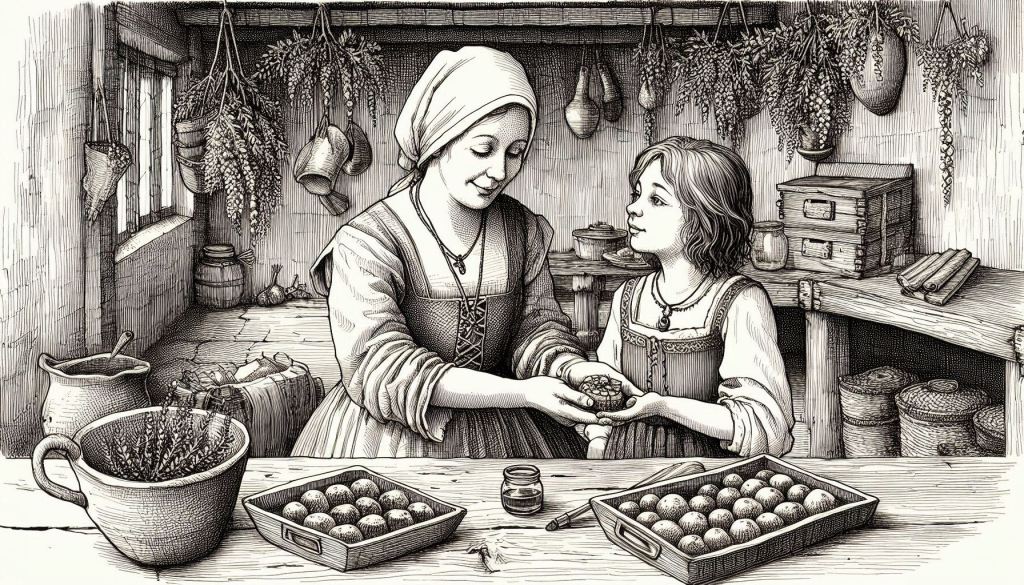
Maud approached the worktable with reverent steps, her eyes wide as they fixed upon the array of marchpane figures—roses and lilies, apples and pears, each one glazed to golden perfection. Agnes took up another piece of the almond paste and began to shape it, her fingers moving with practised grace.
“The secret,” she said, watching Maud’s absorbed expression, “lies not merely in the making, but in the spirit with which it is offered. Food prepared with love carries that love to all who taste it.”
She finished shaping a perfect lily, its petals delicate as those that grew in Lady Catherine’s garden, and drizzled it with honey until it gleamed. Without hesitation, she placed it in Maud’s cupped hands.
“For you,” she said simply. “For your first Midsummer at Alderwyck.”
The child’s eyes widened with wonder and disbelief. “But mistress, this is for the high table—”
“Eat,” Agnes commanded gently, the word carrying all the love and welcome she had received on her own first Midsummer’s Eve. “And remember this night.”
Maud bit into the marchpane with careful reverence, her face transforming as the sweetness flooded her senses. Agnes watched the miracle unfold—the moment when mere sustenance became something transcendent, when kindness revealed itself through the simple sharing of sweetness. The child’s eyes filled with tears of gratitude and wonder, and Agnes felt the circle complete itself.
Outside, the bells of the village church began to toll the hour, their bronze voices carrying across the sleeping countryside. Somewhere beyond these walls, momentous events were unfolding—the death of kings and the birth of new eras—but here in this kitchen, the truly important work continued. The work of nurturing, of teaching, of passing forward the small graces that made life bearable for those who had little reason to hope.
Agnes returned to her marchpane, her hands moving with renewed purpose. Tomorrow’s feast would be magnificent, worthy of the Midsummer tradition and Lady Catherine’s exacting standards. But tonight, she had given a hungry child her first taste of sweetness, and in doing so, had honoured the memory of the woman who had shown her that love could be expressed in sugar and almonds, kindness measured in honeyed gestures.
The kitchen settled into its familiar evening rhythms, but the air seemed somehow lighter, touched with the magic that flowed from one generous heart to another across the years. And if the marchpane roses seemed to glow with unusual warmth in the firelight, if their sweetness carried whispers of gratitude and love, perhaps that was simply the way of Midsummer’s Eve—a night when past and present danced together like flames in the darkness, and the taste of honey could bridge twenty-eight years in a single, sacred moment.
The End
Bob Lynn | © 2025 Vox Meditantis. All rights reserved.


 Vox Meditantis
Leave a comment