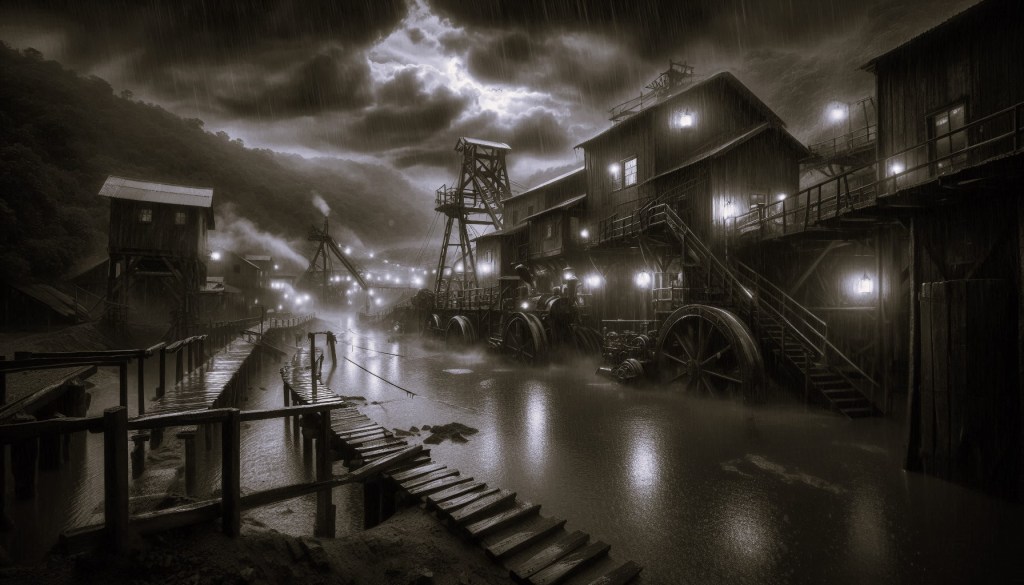
Oriental Mine, Kolar Gold Fields
14th October, 1885
My Dearest Mary,
The monsoon has arrived with a vengeance that would humble even Yorkshire’s fiercest storms, and I find myself writing to you by the light of our miraculous electric lamps whilst rain pounds our quarters with the force of cannon fire. Four months I have been in this strange land now, and I confess that each day brings fresh challenges that test both my resolve and my Yorkshire stubbornness in equal measure.
The rains began in earnest three weeks past, transforming our goldfields from a furnace into something resembling Noah’s flood. The very earth seems to weep continuously, turning the red dust into treacherous mud that clings to a man’s boots with the tenacity of a Yorkshire terrier. Our neat European quarter, which so impressed me upon arrival, now resembles a series of islands connected by planks and raised walkways, whilst the native quarters have become a maze of flooded pathways and makeshift shelters.
But it is the mines themselves, my dear, that present the gravest difficulties. The Oriental Mine, never the most cooperative of workings, has become a battleground against water that would challenge even our most experienced Yorkshire pit engineers. The monsoon rains penetrate every crack and fissure in the rock above, turning our carefully planned drainage systems into inadequate toys against nature’s assault. We pump continuously, day and night, yet still the water rises faster than we can extract it.
MacLeod, our Scottish supervisor, has grown increasingly short-tempered as our productivity plummets. Yesterday he informed our crew that the promised American-made pumping equipment – the very machinery that was to revolutionise our operations – has been delayed indefinitely due to “shipping complications.” Without these pumps, we’re left to battle the flooding with equipment better suited to a village well than a proper mine working. The irony is not lost on me that here, in this land of modern marvels and electric lighting, we find ourselves defeated by the most ancient of mining problems: too much water and too little means to remove it.
Our workforce has dwindled alarmingly these past weeks. The Tamil and Telugu workers, who possess intimate knowledge of monsoon conditions that we Europeans lack, have begun seeking employment at the more successful mines – Champion Reef and Mysore Mine – where the geology proves more favourable and the wages more reliable. Each morning brings fresh departures, leaving us with barely enough hands to maintain basic operations, let alone increase our output to profitable levels.
I must confess, my love, that the physical toll of this work exceeds anything I experienced in our Yorkshire pits. The heat, even tempered by the monsoon rains, saps a man’s strength with relentless efficiency. Several of our European miners have succumbed to what Dr. Stewart terms “tropical exhaustion” – a condition that begins with persistent headaches and weakness, progressing to fever and, in severe cases, complete collapse. Poor Jenkins from Barnsley, whom I mentioned in earlier letters, was confined to the company hospital for over a week with such symptoms, and he’s returned to work a shadow of his former robust self.
My own health, whilst not seriously compromised, shows signs of strain that concern me. The constant dampness has aggravated an old injury to my left shoulder – you’ll remember the accident at Middleton three years past – and I find myself struggling with tasks that once posed no difficulty. The tropical diseases that plague this region have thus far spared me, though I’ve experienced bouts of fever and stomach troubles that Dr. Stewart attributes to the “adjustment period” all Europeans must endure. The medicine he prescribes helps somewhat, though it comes at a cost that further strains my already meagre resources.
Speaking of resources, I must address the matter of wages with painful honesty. The “results-based remuneration” system has proven far less advantageous than the John Taylor & Sons representatives suggested during recruitment. With our mine’s output severely hampered by technical difficulties and monsoon flooding, my earnings for September amounted to barely two-thirds of what I had budgeted for household expenses. The company deducts costs for accommodation, meals, medical care, and even laundry services, leaving precious little to send home or save for emergencies.
MacLeod explained that the Oriental Mine’s poor performance this season reflects “temporary setbacks” that will resolve once proper equipment arrives and weather conditions improve. He speaks confidently of increased productivity during the dry season, assuring us that diligent workers will reap substantial rewards once these current difficulties pass. Yet I observe the same promises being made to crews who arrived months before me, and their circumstances appear no more prosperous than our own.
The social dynamics of this colonial outpost grow increasingly complex as conditions deteriorate. The European staff – engineers, supervisors, and administrative personnel – maintain their comfortable lifestyle regardless of mining productivity, dining at the club and enjoying evening entertainments whilst we workers bear the consequences of operational failures. The rigid hierarchy that initially impressed me with its order now seems designed to shield those in authority from the harsh realities faced by men like myself who actually extract the gold from these reluctant rocks.
Most troubling of all, Mary, is the company’s attitude towards individual miners’ welfare. When Jago Trenwith from Cornwall injured his back in a shaft collapse last month, he was provided minimal medical care before being informed that extended absence from work would result in termination and immediate deportation. The man has worked diligently for eight months, yet faces dismissal because his injury prevents him from meeting productivity quotas. Such treatment leaves me questioning the security of my own position, particularly as my shoulder troubles occasionally limit my effectiveness.
The monsoon season has brought its own catalogue of miseries beyond mere flooding. Tropical diseases flourish in the humid conditions, and our quarters echo nightly with the coughing and moaning of men battling fever, dysentery, and ailments whose names I cannot pronounce. The company hospital, whilst adequately equipped, seems perpetually overwhelmed, and Dr. Stewart confided that he’s treating more cases of serious illness than during the dry season. Several miners have died – not from mining accidents, but from diseases that seem to strike without warning, claiming vigorous men within days of their first symptoms.
Yet despite these trials, I cling to hope and determination, my beloved. The gold remains in these hills, waiting for men brave enough and skilled enough to extract it. My Yorkshire experience with flooding continues to prove valuable – indeed, MacLeod has consulted me repeatedly about drainage techniques that might be adapted to our current situation. If we can weather this monsoon season and receive the promised equipment, the Oriental Mine might yet prove profitable for all concerned.
I dream often of our little family, and these dreams grow more vivid with each passing week. Sometimes I wake believing I can hear young William’s laughter or smell the bread you bake on Sundays. Such dreams provide comfort during the most difficult moments, though they also intensify the ache of separation. When I calculate the months remaining before I might reasonably return to Yorkshire – assuming our mining venture proves successful – the time stretches before me like an endless tunnel whose end remains shrouded in darkness.
The children must be growing so rapidly in my absence. Does Margaret still draw her fanciful pictures, and has young William begun helping with household tasks as I instructed? Most importantly, how fares our little Edward? Your last letter mentioned his persistent cough, and I worry that our Yorkshire winters might prove harsh for his delicate constitution. If my earnings this season prove insufficient to return home by Christmas as originally planned, I must consider extending my stay until the following spring, when I might accumulate enough resources to justify this tremendous sacrifice.
I’ve enclosed a small quantity of gold dust – genuine particles extracted from the Oriental Mine’s modest output. The company permits each worker to retain such minimal amounts as a memento of their service, though naturally all significant discoveries belong to John Taylor & Sons. Let the children hold this treasure and know that their father handles such wonders daily, even if current circumstances prevent him from sending the substantial remittances we had hoped for.
The electric lights continue to amaze me, particularly during these dark monsoon evenings when they transform our flooded compound into an island of brilliance amidst the tropical deluge. Such modern marvels remind me that I witness the future of industry, even as I struggle with ancient problems of water, stone, and human endurance. Perhaps our children will inhabit a world where such innovations are commonplace, where electric light banishes darkness from every English home and mechanical wonders ease the burdens that currently fall upon human muscle and determination.
Kiss our dear ones for me, and tell them their father labours in a land where the very air seems alive with moisture and possibility. Though current circumstances test my resolve severely, I remain convinced that persistence and Yorkshire grit will ultimately triumph over these temporary setbacks. The gold is here, Mary – I see it daily in the ore we extract – and patient men who endure hardship will eventually claim their reward.
Until I can hold you in my arms once more, I remain your devoted and determined husband, fighting against flood and fever to secure our family’s future in this strange and challenging land.
Your loving husband,
William Baldwin
P.S. – The monsoon rains have made postal service irregular, so do not worry if my letters arrive less frequently than before. I shall write whenever possible, though sometimes the conditions make such correspondence difficult. Keep faith in my determination to return to you wealthy enough to justify this tremendous sacrifice we have both made.
◄ Go back to part 4 | Continue to part 6 ►
Bob Lynn | © 2025 Vox Meditantis. All rights reserved.

 Vox Meditantis
Leave a comment