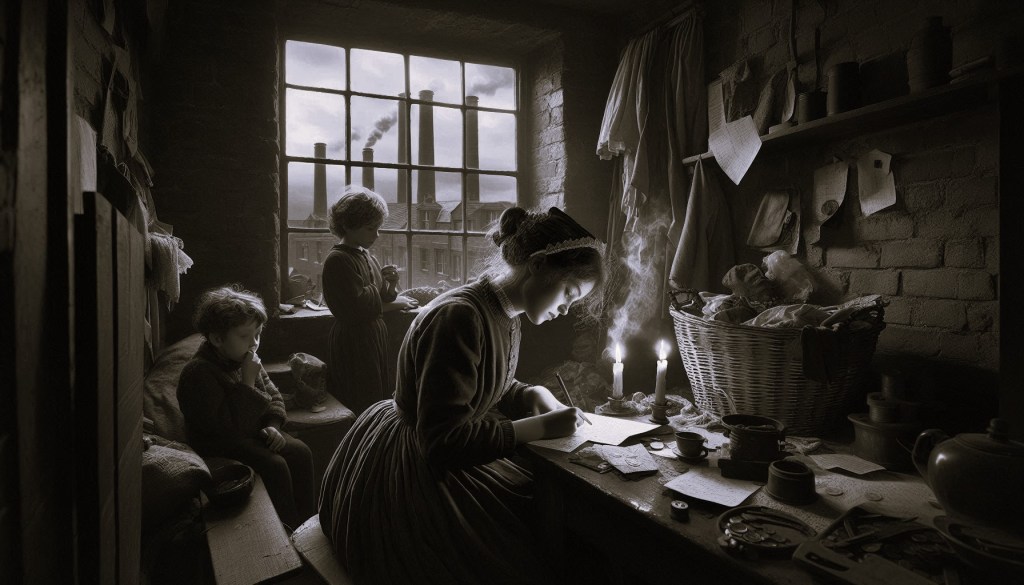
17 Dawson Street, Holbeck
28th August, 1885
My Dearest William,
Your letter from the goldfields arrived on Tuesday last, and I confess I’ve read it so many times that the paper has grown soft from handling. How my heart soared to learn that you’ve arrived safely at your destination, and what marvels you describe! Electric lighting that banishes the darkness – imagine such a thing! Young William made me read that passage thrice over, and he’s been pestering poor Mr. Henderson about whether such miracles might one day come to Leeds. I told him his father is witnessing the very future of our world, though I pray it’s a future that includes his swift return to Yorkshire.
The children were quite beside themselves with excitement over your descriptions of the great machines and the brilliant birds. Margaret has taken to drawing what she imagines your “Little England” must look like, complete with palm trees growing beside neat English gardens. Her artistic efforts may lack accuracy, but her enthusiasm knows no bounds. She’s convinced you’re living in a palace and keeps asking when we might visit this magical place where the very earth glows with captured starlight.
Yet, my darling husband, whilst I rejoice in your wonder at these modern marvels, I cannot help but notice what you haven’t said as much as what you have. When you mention your accommodation so briefly, or speak of wages to be “calculated based on productivity,” I hear the careful words of a man trying not to worry his wife. Twenty years of marriage have taught me to read between your lines, William Baldwin, and I sense that all is not quite as golden as the John Taylor & Sons representatives led us to believe.
Still, I’m tremendously proud of your courage and determination. The very idea that Yorkshire mining knowledge serves you well in such exotic circumstances fills me with satisfaction. When Mrs. Braithwaite remarked rather snidely that her cousin’s husband found work in Sheffield rather than “gallivanting off to heathen lands,” I told her firmly that my William possesses skills valuable enough to take him to the ends of the earth. Not every man can master water management in foreign mines, and I’ve no doubt your experience will prove its worth.
I must share some troubling news from our neighbourhood, though I hesitate to burden you with sorrows when you face your own challenges. This summer has been uncommonly harsh – not with heat, as you describe in India, but with a damp, oppressive warmth that seems to breed sickness. Poor Mrs. Pritchard lost her baby boy – little James, who was but six months old. The doctor said it was the summer fever, though between you and me, I think it was as much poverty as illness that took the child. Mrs. Pritchard couldn’t afford proper medicine, and the baby never had the strength to fight off the sickness.
The funeral was heartbreaking, William. The whole street turned out, each family contributing what they could for a decent burial. Mrs. Pritchard bore it with such dignity, though I could see her heart was breaking. It reminded me sharply of how precious our own children are, and how many dangers lurk even in familiar places. When I watch our little Edward coughing in the mornings, my chest grows tight with worry.
Yes, our youngest has been battling a persistent cough these past weeks. Nothing too alarming, Dr. Halewood assures me, but it lingers despite all my remedies. The damp air seems to settle in his chest, and though he plays and eats well enough during the day, his nights are often restless. Mrs. Braithwaite has given me a receipt for a chest rub made with goose fat and camphor, which seems to ease him somewhat. Still, I find myself listening for his breathing in the dark hours, remembering poor Mrs. Pritchard’s loss.
The economic situation here grows increasingly troublesome. Three more families on our street have had their wages cut or lost work entirely. The Kellys received notice that Mr. Kelly’s hours at the foundry would be reduced to half-time, and they’re talking of taking in lodgers to make ends meet. Mrs. Henderson says it’s the foreign competition – cheaper coal from Wales and the continent making Yorkshire pits less profitable. The mine owners seem determined to squeeze every penny from their workers rather than accept reduced profits themselves.
In light of these circumstances, I’ve taken decisive action to help our family’s finances. Mrs. Atkinson at the mill has found me additional mending work – not just from our immediate neighbours, but from some of the better-off families near the park. Three times weekly now, I collect baskets of linens, undergarments, and household items that need careful repair. The work is meticulous – some of these fine ladies expect stitches so neat they’re nearly invisible – but I find satisfaction in the precision required.
Little Margaret has become my assistant, sorting buttons and measuring thread with the seriousness of a proper seamstress. She shows remarkable aptitude for the work, her small fingers perfect for the most delicate tasks. “I’m helping Papa by helping Mama,” she announced yesterday, which brought tears to my eyes. Even young William contributes by delivering finished work to customers, though I must remind him repeatedly not to dawdle or get distracted by street games.
The additional income proves most welcome. Between my mill work two days weekly and the mending, I’m managing to put aside a few shillings each month. Not as much as we’d hoped your Indian wages would contribute, but enough to ensure we won’t touch our small savings unless absolutely necessary. I’ve become quite clever at stretching our household budget – buying day-old bread from Hawkins’, trading mending services for vegetables with Mrs. Patterson, and making hearty soups from bones that cost mere pennies.
Our community continues to rally around each other in these difficult times. When the Robinsons needed help during Mr. Robinson’s week of illness, we organised a system where each family contributed an evening meal. Mrs. Braithwaite coordinated the effort with military precision, ensuring they never went hungry whilst maintaining their dignity. Such networks of mutual support remind me that whilst we may lack material wealth, we’re rich in human kindness.
The children speak of you constantly, weaving your adventures into their daily play. They’ve created an elaborate game where they take turns being “Papa in India,” complete with imaginary elephants and treasure hunts. Young William has appointed himself the “mine supervisor” and directs the other children in digging operations that leave Mrs. Patterson’s garden looking like a battlefield. I haven’t the heart to curtail their enthusiasm, as it clearly helps them feel connected to your distant endeavours.
I must ask about your health, my dear. Your descriptions of the intense heat concern me greatly. Are you taking proper precautions against the sun? Do you have adequate medical care should you need it? The thought of you falling ill so far from home fills me with dread. Please promise me you’ll not push yourself beyond reasonable limits, regardless of any pressure from supervisors or expectations about productivity.
Your piece of gold-bearing quartz sits proudly on our mantelpiece, where the children examine it daily with the reverence usually reserved for religious relics. Margaret insists it glows with its own inner light, though I suspect that’s her imagination rather than any natural property of the stone. Nevertheless, it serves as a tangible reminder of your purpose and determination, a physical link to your exotic world.
The neighbours have shown considerable interest in your letters and the small specimen you sent. Mrs. Henderson declares you’re likely to return wealthy as a lord, whilst Mr. Patterson wants to know whether there might be opportunities for skilled ironworkers in the goldfields. I told him I’d mention his inquiry, though privately I hope no other families from our street feel compelled to make such dramatic sacrifices for uncertain prospects.
As autumn approaches, I find myself counting the months until your planned return. The children ask daily when Papa will come home, and I tell them that brave fathers sometimes must travel far to secure their families’ futures. Yet I confess, William, that your absence grows harder rather than easier to bear. The house feels incomplete without your presence, and I miss our evening conversations more than I can adequately express.
Please write to me of everything – your daily routines, the men you work with, the strange foods you eat, and most importantly, your true feelings about your situation. Don’t spare my sensibilities with overly cheerful accounts if reality proves harsh. I’d rather know the truth and worry appropriately than imagine dangers worse than those you actually face.
Until your next letter arrives, know that your family thinks of you with every sunrise and prays for your safety with every sunset. We count the days until you return to us, bearing not just gold from distant mines, but stories of courage and determination that will inspire our children for years to come.
Your devoted and loving wife,
Mary Baldwin
P.S. – I’ve enclosed a small sprig of heather from the moors beyond Leeds, pressed carefully between the pages of mother’s old Bible. May it remind you of Yorkshire’s beauty whilst you labour beneath India’s burning sun. The children send their love and a thousand kisses carried on the wind across the ocean.
◄ Go pack to part 3 | Continue to part 5 ►
Bob Lynn | © 2025 Vox Meditantis. All rights reserved.

 Vox Meditantis
Leave a comment