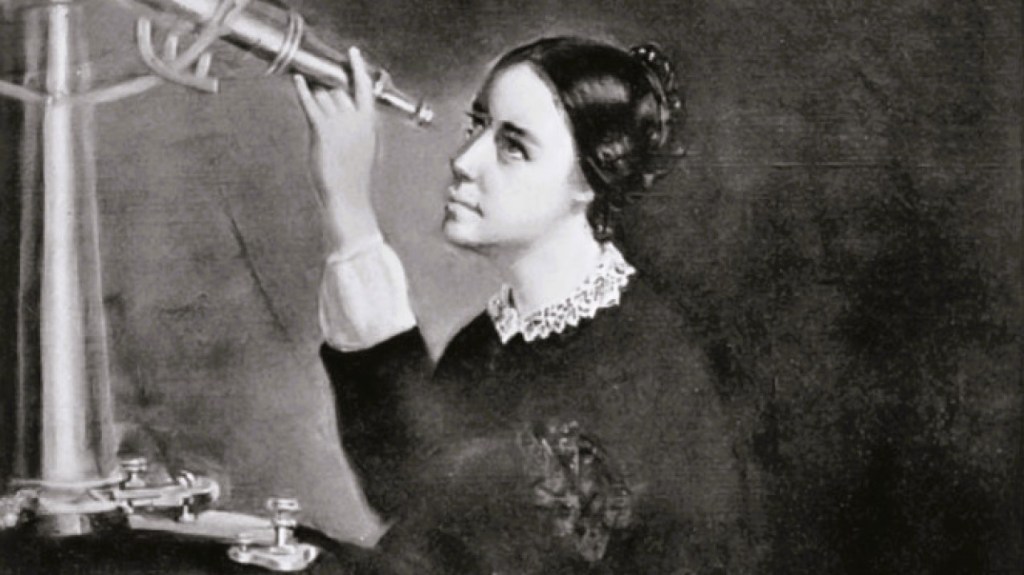
On a crisp October evening in 1847, whilst fashionable society gathered in parlours across Nantucket, Maria Mitchell climbed to the roof of the Pacific Bank where her father worked as head cashier. Armed with nothing more than a two-inch telescope and a relentless determination to chart the heavens, she was about to make history. What she discovered that night—a small, blurry streak invisible to the naked eye—would transform her from an obscure librarian into America’s first professional female astronomer. Yet today, whilst we celebrate Marie Curie and Dorothy Hodgkin, Mitchell’s name has faded from public consciousness, a stark reminder of how easily women’s contributions to science can be erased by time.
A Quaker Foundation for Scientific Excellence
Mitchell’s path to astronomical greatness began in the most unlikely of places: a modest Quaker household on Nantucket Island. Born on 1st August 1818 to William and Lydia Mitchell, she was the third of ten children in a family that defied every convention of 19th-century education. Her parents, devout Quakers, embraced the radical notion that girls deserved the same quality of education as boys—a belief that would prove revolutionary in shaping America’s first generation of female scientists.
The Quaker tradition of intellectual equality wasn’t merely progressive rhetoric in the Mitchell household; it was lived practice. William Mitchell, himself an accomplished amateur astronomer and teacher, recognised his daughter’s exceptional mathematical abilities early on. By age twelve, Maria was calculating the precise timing of solar eclipses alongside her father. By fourteen, ship captains entrusted her with rating their chronometers for lengthy whaling voyages—a responsibility that spoke volumes about her reputation for precision and reliability.
This wasn’t simply a case of paternal indulgence. Nantucket’s unique social fabric, shaped by its maritime economy, created an environment where women’s intellectual capabilities were valued rather than suppressed. With husbands away on whaling expeditions for months or years, wives managed businesses, made financial decisions, and maintained households with remarkable independence. This culture of female self-reliance provided the perfect incubator for Mitchell’s scientific ambitions.
From Librarian to Comet Hunter
In 1836, Mitchell accepted the position of first librarian at the Nantucket Atheneum, a role that would define her pre-fame years. For twenty years, she spent her days surrounded by books, serving as an informal educator and intellectual catalyst for the island’s residents. The Atheneum became a meeting place for forward-thinking luminaries including Ralph Waldo Emerson, Henry David Thoreau, and Frederick Douglass. Yet Mitchell’s true passion lay not in the volumes she catalogued during daylight hours, but in the celestial observations she conducted each night.
Every clear evening, Mitchell would ascend to the roof of the Pacific Bank, where she and her father had established their modest observatory. Using their collection of astronomical instruments, she systematically “swept the heavens,” searching for new celestial phenomena. Her methodical approach reflected both her Quaker upbringing—with its emphasis on careful observation and quiet persistence—and her mathematical training.
The discovery that would change everything occurred on 1st October 1847. While scanning the sky through her telescope, Mitchell spotted a small, nebulous object that didn’t appear on any of her star charts. Her scientific training kicked in immediately; rather than rushing to announce the discovery, she spent several nights confirming her observations and calculating the object’s orbit. When she finally shared her findings with her father, he was so excited that he wanted to declare the discovery immediately, but Mitchell’s cautious nature prevailed.
The Comet That Made History
What Mitchell had discovered was C/1847 T1, which would become known worldwide as “Miss Mitchell’s Comet”. The discovery was particularly significant because she was only the third woman in history to discover a comet, following Caroline Herschel and Maria Margarethe Kirch, both German astronomers. More importantly for American science, she was the first American of either gender to make such a discovery.
The timing couldn’t have been more fortuitous. King Frederick VI of Denmark had established a prize for anyone who discovered a new telescopic comet, and his successor, Christian VIII, continued this tradition. After European astronomers confirmed that Mitchell had observed the comet before other discoverers, including Father Francesco de Vico in Rome, she was awarded the gold medal. The inscription, drawn from Virgil’s Georgics, read “Non Frustra Signorum Obitus Speculamur et Ortus”—”Not in vain do we watch the setting and rising [of the stars]”.
The discovery thrust Mitchell into the international spotlight with unprecedented force. Newspapers worldwide carried headlines about the “lady astronomer” from Nantucket. Scientific societies that had never admitted women suddenly found themselves confronting this exceptional candidate. In 1848, she became the first woman elected to the American Academy of Arts and Sciences—a distinction she would hold alone for nearly a century.
Breaking Barriers at Vassar College
Mitchell’s growing reputation as both a scientist and an advocate for women’s education made her an obvious choice when Vassar College sought to establish its astronomy programme. In 1865, she became the institution’s first professor of astronomy and director of the Vassar College Observatory, making her the first woman to hold such positions in America.
At Vassar, Mitchell revolutionised how astronomy was taught. Rather than confining her students to textbook learning, she insisted they conduct original research and make their own observations. Her students regularly published their findings alongside her own work, participating in national scientific experiments that would have been unthinkable for women just a generation earlier. During the 1878 solar eclipse, Mitchell and five of her students served as official observers near Denver, Colorado—a mark of the respect she had earned within the scientific community.
Mitchell’s impact extended far beyond the observatory dome. She discovered that despite her international reputation and pioneering achievements, she was being paid less than younger, less experienced male colleagues. Her response was characteristically direct: she and her female colleague Alida Avery demanded equal pay, and they received it. This early victory in the fight for gender pay equity demonstrated Mitchell’s understanding that true equality required more than mere recognition—it demanded systemic change.
Champion of Women’s Rights
Mitchell’s commitment to advancing women’s opportunities in science led her to co-found the Association for the Advancement of Women in 1873. As the organisation’s president from 1875 to 1877, she used her platform to argue passionately for women’s educational and professional rights. Her 1876 speech, “The Need of Women in Science,” remains a powerful articulation of the barriers facing women scientists.
“Does anyone suppose that any woman in all the ages has had a fair chance to show what she could do in science?” Mitchell asked her audience. “Until able women have given their lives to investigation, it is idle to discuss the question of their capacity for original work”. These words, delivered at the height of her fame, captured both her frustration with systemic discrimination and her determination to create opportunities for future generations.
Mitchell’s advocacy wasn’t limited to rhetoric. She actively mentored her students, encouraging them to pursue careers in science and education. Many went on to distinguished careers, including Mary Watson Whitney, who succeeded Mitchell as director of the Vassar Observatory. Whitney herself became the first president of the Maria Mitchell Association, ensuring her mentor’s legacy would endure.
The Puzzle of Forgotten Fame
The mystery of Mitchell’s fading reputation offers a sobering lesson about how women’s contributions to science can be systematically erased. During her lifetime, Mitchell was genuinely famous—a household name whose achievements were celebrated in newspapers, honoured by royalty, and recognised by the most prestigious scientific institutions. Yet within decades of her death in 1889, her story had begun to slip from public memory.
Several factors contributed to this decline. Unlike Marie Curie, whose Nobel Prizes provided enduring markers of achievement, Mitchell’s recognition came primarily through professional memberships and medals that held less public resonance over time. The rise of professional astronomy in the early 20th century, with its emphasis on advanced mathematical training and specialised research, may have made Mitchell’s more observational approach seem outdated.
More fundamentally, Mitchell’s fate reflects what historian Margaret Rossiter termed the “Matilda effect”—the systematic suppression of women’s contributions to scientific progress. As new generations of scientists emerged, the achievements of pioneering women were often minimised or forgotten entirely, their work absorbed into a narrative that privileged male contributions.
A Legacy That Endures
Despite the fading of her popular fame, Mitchell’s influence on American science education remains profound. The Maria Mitchell Association, founded in 1902, continues to operate observatories, educational programmes, and research facilities on Nantucket. Her approach to hands-on, observational learning has become standard practice in astronomy education.
More significantly, Mitchell’s career established a template for women’s participation in American science. She demonstrated that women could excel in rigorous scientific research, lead educational institutions, and advocate for social change simultaneously. Her students and their students carried forward this model, creating networks of women scientists that would prove crucial for the profession’s development.
Mitchell’s story also illuminates the precarious nature of historical memory, particularly for women’s achievements. Her transformation from celebrated scientist to forgotten pioneer serves as a reminder that progress isn’t linear, and that each generation must actively work to preserve and honour the contributions of those who came before.
Reclaiming a Scientific Pioneer
Today, as we contend with persistent gender disparities in STEM fields, Maria Mitchell’s life offers both inspiration and instruction. She succeeded not because discrimination didn’t exist, but because she possessed the determination to confront it directly. Her insistence on equal pay, her mentoring of younger women, and her public advocacy for educational reform established practices that remain relevant today.
Mitchell understood that individual achievement, however remarkable, wasn’t enough to create lasting change. True progress required institutional transformation, systematic advocacy, and the cultivation of future generations of women scientists. Her legacy challenges us to remember that the women who opened doors in science often did so through extraordinary effort and against formidable odds.
The comet that made Maria Mitchell famous has long since disappeared into the depths of space, but her contributions to American science education and women’s rights deserve to shine as brightly today as they did in her remarkable lifetime. In celebrating her achievements, we honour not just one exceptional woman, but the countless others whose contributions to human knowledge have been obscured by time and circumstance.
Bob Lynn | © 2025 Vox Meditantis. All rights reserved.

 Vox Meditantis
Leave a comment