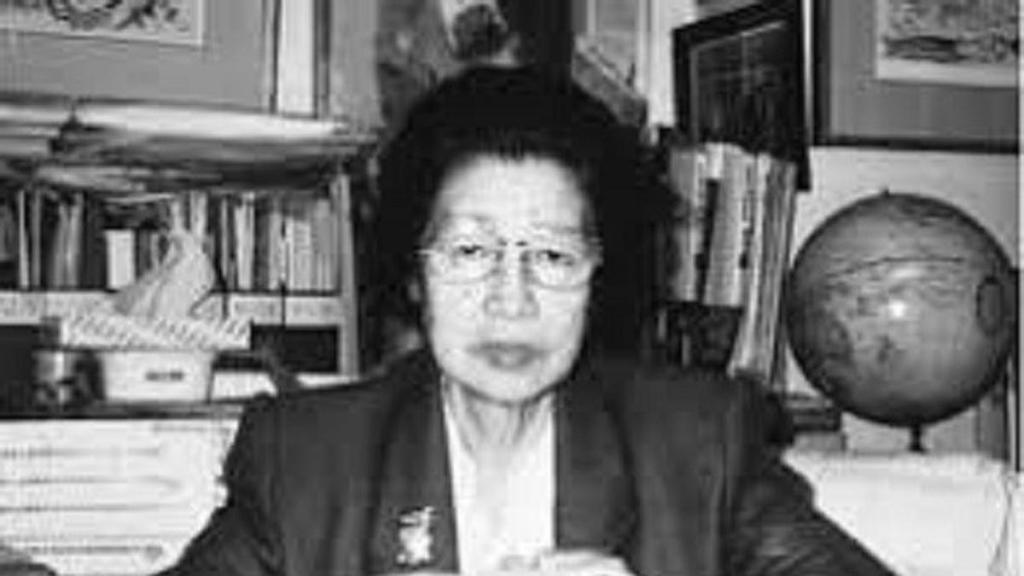
Her tools measured what others couldn’t see. Her courage challenged what others wouldn’t confront. Yet the world barely remembers her name.
In the pantheon of scientific achievement, certain figures cast long shadows whilst others labour in relative obscurity—not through any deficiency in their contributions, but through the systematic erasure that befalls those who don’t fit the traditional mould of scientific authority. Katsuko Saruhashi stands as a towering example of this injustice: a Japanese geochemist whose groundbreaking work fundamentally transformed our understanding of oceanic chemistry and nuclear contamination, yet whose legacy remains largely confined to specialist circles whilst her Western male contemporaries enjoy household recognition.
Early Life and the Making of a Scientist
Born in Tokyo on 22nd March 1920, Katsuko Saruhashi’s path to scientific prominence began with a child’s wonder at raindrops cascading down a classroom window. This simple fascination with water’s behaviour would eventually reshape global environmental science. Her parents, Kuniharu and Kuno Saruhashi, recognised the crucial importance of education—particularly for women in post-war Japan, where technical knowledge meant financial independence.
The young Saruhashi initially worked at an insurance firm, but at age 21, she made a decision that would alter the course of scientific history. Against conventional expectations, she quit her secure position to attend the Imperial Women’s College of Science (now Toho University), graduating with a chemistry degree in 1943. This bold move reflected both personal determination and the harsh realities of wartime Japan, where women witnessed firsthand the vulnerability that came with financial dependence.
Mentorship and the Foundation of Excellence
Saruhashi’s scientific career took flight when she joined the Geochemical Laboratory at the Meteorological Research Institute, working under the mentorship of Yasuo Miyake. This relationship proved transformative—not merely because Miyake provided access to government laboratory facilities, but because he embodied a revolutionary principle: that scientific merit transcended gender. For Miyake, dedication and commitment to pursuing problems mattered far more than whether a researcher was male or female.
This mentorship enabled Saruhashi to tackle problems that others deemed insignificant. In the 1940s and 1950s, when few scientists paid attention to carbon dioxide levels in seawater, Saruhashi recognised the fundamental importance of this measurement. Working with limited equipment and pioneering her own methodologies, she developed what became known as “Saruhashi’s Table”—a revolutionary system for determining carbon dioxide levels based on three critical parameters: temperature, pH, and chlorinity.
Pioneering CO₂ Measurement: The Foundation of Climate Science
Saruhashi’s development of precise CO₂ measurements in seawater represented a quantum leap in oceanographic science. Her method became the global standard for gauging concentrations of carbonic acid in water—a tool that remains fundamental to climate research today. The significance of this achievement extends far beyond technical innovation; Saruhashi’s work revealed that the Pacific Ocean releases approximately twice as much carbon dioxide as it absorbs, fundamentally challenging assumptions about the ocean’s capacity to mitigate global warming.
“Now everyone is concerned about carbon dioxide, but at the time nobody was,” Saruhashi reflected years later. This observation captures the essence of pioneering science—the ability to recognise significance where others see triviality. Her prescient focus on oceanic CO₂ laid crucial groundwork for contemporary climate science, yet this contribution remains largely unacknowledged in popular accounts of climate research history.
In 1957, Saruhashi became the first woman to earn a doctorate in chemistry from the prestigious University of Tokyo—a barrier-breaking achievement that should have commanded international attention. Instead, it passed with little fanfare, illustrating the systematic undervaluation of women’s scientific achievements.
Nuclear Fallout Research: Science in Service of Humanity
Saruhashi’s second revolutionary contribution emerged from tragedy. In 1954, the crew of the Japanese fishing vessel Daigo Fukuryū Maru fell mysteriously ill after being exposed to radioactive fallout from US nuclear testing at Bikini Atoll. The Japanese government commissioned the Geochemical Laboratory to investigate oceanic nuclear contamination—a task that fell to Saruhashi and her colleagues.
Her research methodology was both elegant and revolutionary. By developing sensitive techniques for measuring radioactive isotopes—particularly Cesium-137 and Strontium-90—in seawater, Saruhashi could track the movement of nuclear contamination across vast oceanic distances. Her findings were both alarming and definitive: radioactive fallout from Pacific nuclear tests reached Japan in just 18 months, and the contamination was spreading far beyond the immediate testing areas.
The implications were staggering. Saruhashi’s data demonstrated that nuclear testing posed global, not merely local, risks. Her research revealed how ocean currents carried radioactive materials across international boundaries, making every nuclear test a potential threat to distant populations. These findings directly contributed to the 1963 Partial Test Ban Treaty, which prohibited atmospheric nuclear testing.
Confronting Scientific Racism and Proving Excellence
Saruhashi’s international recognition came through a remarkable demonstration of scientific rigour. In 1961, American researchers questioned her measurements of cesium levels in Japanese coastal waters, suggesting her figures were excessively high compared to US data. Rather than accept this dismissal, Saruhashi travelled to the United States and engaged in a direct analytical competition using identical test samples.
She won decisively. This victory accomplished far more than vindicating her methodology—it demonstrated the superior accuracy of Japanese analytical techniques whilst proving the severity of nuclear contamination that American scientists had underestimated. Yet this extraordinary validation of her scientific excellence remains largely unknown outside specialist circles.
Breaking Barriers and Building Institutions
Saruhashi’s achievements extended beyond research into institutional transformation. In 1980, she became the first woman elected to the Science Council of Japan—a recognition that should have marked a watershed moment for women in Japanese science. In 1985, she became the first woman to receive the Miyake Prize for geochemistry, an award named after her mentor.
But Saruhashi recognised that individual achievement meant little without systemic change. In 1958, she founded the Society of Japanese Women Scientists, creating a support network for women in science at a time when such solidarity was desperately needed. The society’s mission extended beyond professional advancement to encompass world peace—reflecting Saruhashi’s belief that scientific knowledge should serve humanity’s welfare rather than its destruction.
The Saruhashi Prize: A Legacy of Mentorship
Upon her retirement in 1980, Saruhashi’s colleagues presented her with five million yen. She used this money to establish the Association for the Bright Future of Women Scientists and created the Saruhashi Prize, awarded annually to Japanese women scientists who serve as role models for younger researchers. This initiative embodied her philosophy: “There are many women who have the ability to become great scientists. I would like to see the day when women can contribute to science and technology on an equal footing with men”.
The prize continues today, having recognised dozens of outstanding female scientists across multiple disciplines. Yet even this institutional legacy reflects the broader pattern of Saruhashi’s career—profound impact coupled with insufficient recognition.
The Systematic Erasure of Excellence
Why does Saruhashi remain largely forgotten whilst her Western male contemporaries achieve lasting fame? The answer lies in the intersection of gender, nationality, and scientific power structures that dominated the mid-20th century. During the 1950s and 1960s, scientific authority was overwhelmingly concentrated in American and European institutions led by white men. Women scientists, particularly those from non-Western countries, faced double marginalisation—their gender rendered them invisible whilst their nationality relegated their work to secondary status.
Saruhashi’s contributions to climate science preceded the Western scientific establishment’s engagement with these issues by decades. Her nuclear contamination research provided crucial data that informed international policy, yet Western accounts of nuclear testing’s environmental impact rarely acknowledge her foundational work. This pattern reflects broader dynamics of scientific colonialism, where knowledge produced outside Western institutions receives insufficient credit even when it proves superior in accuracy and insight.
A Scientist’s Philosophy
Saruhashi understood science as inherently linked to social responsibility. “A-bomb victims in Hiroshima and Nagasaki and those exposed to radiation in the Bikini Atoll are fathers, mothers, and brothers,” she wrote. This humanistic approach to scientific inquiry—viewing research subjects as fellow human beings rather than abstract data points—distinguished her work and motivated her anti-nuclear activism throughout her career.
She served as a director of the Daigo Fukuryū Maru Peace Association from 1982 until her final years, continuing to advocate for nuclear disarmament and the peaceful application of scientific knowledge. Her philosophy remained consistent: “Truths discovered by scientists are common assets of humankind and should be used and developed only for human happiness and well-being. They must not be used to kill people in other countries”.
Reclaiming Recognition
Katsuko Saruhashi died of pneumonia on 29th September 2007, at age 87. Her passing received modest attention—a fitting metaphor for a career characterised by transformative contributions coupled with inadequate recognition. Yet her legacy demands broader acknowledgement, not merely as historical correction but as inspiration for contemporary science.
Saruhashi’s story demonstrates that scientific excellence transcends traditional boundaries of gender, nationality, and institutional affiliation. Her work laid foundations for climate science, transformed nuclear policy, and created lasting institutions supporting women in science. These achievements deserve recognition not as footnotes to scientific history, but as central chapters in humanity’s expanding understanding of our planet and our responsibilities to it.
The time has come to restore Katsuko Saruhashi to her rightful place in the scientific pantheon—not as an exception to be celebrated, but as an exemplar of the excellence that emerges when barriers fall and merit prevails. Her legacy challenges us to examine not only what we know about our changing world, but how we decide whose contributions count and whose voices matter in shaping our collective future.
Bob Lynn | © 2025 Vox Meditantis. All rights reserved.

 Vox Meditantis
Leave a comment