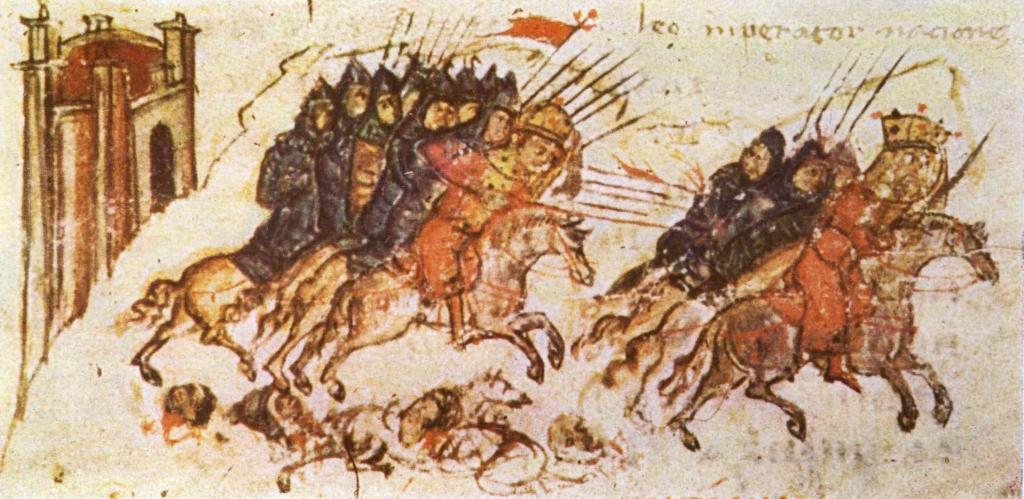
Constantinople, Byzantine Empire — 9th June, 813 CE
The Chronicle Begins
I, Callistus of the Monastery of St John Stoudios, set quill to parchment on this ninth day of June, in the year of our Lord eight hundred and thirteen, as Constantinople trembles beneath the weight of empire’s shifting foundations. The ink pools dark as blood upon my desk, and I wonder—as I have wondered these past troubled months—what words might truly capture the essence of a soul.
Today, Emperor Michael Rangabe abdicated his throne. The news arrived with the morning bells, carried by breathless messengers who spoke in hushed tones of defeat at Versinikia, of Bulgarian steel, and of Leo the Armenian’s inevitable ascension. Yet as I prepare to chronicle these momentous events for posterity, a peculiar question haunts my mind: if each of us possessed but a single line to define our existence—a tagline, as merchants brand their wares—what truths would we dare inscribe?
The thought came to me three nights past, as I transcribed the final letters of Emperor Michael’s reign. Words, I realised, are the only things that outlive flesh, yet we spend so little time considering which words might best capture our essence. And so, driven by a philosopher’s curiosity and a chronicler’s duty, I have undertaken a most unusual task: to discover the taglines of those who shape our empire’s fate.
The Emperor’s Daughter
Anna Rangabe received me in the shadow of the Great Palace’s eastern wing, where the afternoon light filtered through latticed windows to cast geometric patterns upon marble floors. She stood with her back to me, gazing towards the Bosphorus, her silhouette framed by the dying glory of an empire that had been her birthright mere hours before.
“Sister Anna,” I began, using the title that would soon lose all meaning, “I come not as chronicler of your father’s reign, but as one who seeks to understand the deeper currents that move us all.”
She turned, and I saw in her dark eyes neither tears nor rage, but a clarity that unnerved me. At twenty-three, she possessed the sharp intelligence that her father, for all his piety, had somehow failed to inherit.
“Speak plainly, Callistus. The day for courtly circumlocution has passed.”
“If you could distil your essence into a single phrase—a line by which history might remember not your station, but your soul—what would it be?”
A smile played at the corners of her mouth, though whether from amusement or bitterness, I could not discern. She moved to a small table where maps of the empire lay scattered, their edges curling like autumn leaves.
“You ask this on the day my family falls from grace? How fitting.” She traced the boundaries of Thrace with one slender finger. “My father believed that righteousness alone could preserve an empire. He thought God would reward his devotion with victory, his prayers with prosperity.” She looked up at me, her gaze penetrating. “But I have studied Procopius and Agathias. I have read the secret histories. I know that empires are built not on prayer, but on the willingness to see truth, however ugly it may be.”
“And your tagline?”
She was quiet for a long moment, her fingers still tracing invisible borders upon the map. When she spoke, her voice carried the weight of profound disillusionment.
“‘Truth wears no crown.’” She straightened, squaring her shoulders. “That would be my line, Brother Callistus. For I have learned that those who speak honestly seldom rule, and those who rule seldom speak honestly. Perhaps if my father had understood this paradox, Constantinople would not now prepare for a new master.”
I made note of her words, struck by their painful accuracy. Here was a woman who might have ruled with both wisdom and pragmatism, had she been born male. Instead, she would fade into the chronicles as merely “daughter of the deposed emperor,” her insights lost to history’s masculine prejudices.
The Ascending Lion
Leo the Armenian agreed to meet me in the Chrysotriklinos, the golden reception hall where tomorrow he would likely receive the imperial crown. Even now, servants scurried about removing the personal effects of the Rangabe family, replacing them with symbols more to Leo’s taste. The man himself stood before the great throne, his hands clasped behind his back, studying the eagle carved into its gilded arms.
“An interesting request, Brother,” he said without turning. “Most men seek to know my plans for the empire. You ask instead for my essence reduced to a single phrase.”
Leo was a soldier’s soldier—broad-shouldered, scarred, with grey threading through his black beard. He had survived the Persian campaigns, the Arab raids, the endless palace intrigues that devoured lesser men. His survival itself spoke to a particular genius for reading the currents of power.
“Plans change, General,” I replied. “Empires rise and fall. But a man’s fundamental nature—that remains constant.”
He laughed, a sound without warmth. “Does it? I have been farmer’s son, common soldier, commander, conspirator, and tomorrow, God willing, emperor. Which of these is my ‘fundamental nature’?”
“Perhaps that is precisely the question worth exploring.”
Leo finally turned to face me, his pale eyes calculating. I sensed he was a man who thought three moves ahead in every conversation, every relationship. “You know what they whisper about me in the corridors? That I am opportunistic, faithless, power-hungry. They say I betrayed Michael not from principle, but from ambition.”
“And is this true?”
“Truth?” He moved to the great window overlooking the Hippodrome, where even now workers were preparing for the coronation ceremonies. “Truth is what survives, Brother. History is written by victors, not by the righteous.” He paused, watching the bustle below. “But if I must choose a tagline, let it be this: ‘History bends to those who seize it.’”
I felt a chill at his words, recognising in them both the pragmatism that might save the empire and the hubris that might damn it. Leo understood power in ways that Michael never had, but I wondered if he understood the cost of wielding it so nakedly.
“You believe, then, that fate is entirely within our control?”
“I believe that men who wait for fate to favour them die waiting.” He turned back to the throne, and I saw him already imagining himself upon it. “The Arabs press us from the south, the Bulgars from the north. Constantinople needs an emperor who acts, not one who merely prays.”
As I departed the golden hall, I reflected that Leo’s tagline revealed both his strength and his potential downfall. History might indeed bend to those who seized it, but it had a way of breaking those who bent it too far.
The Foreign Voice
I found Tervel in the monastery’s guest quarters, where foreign dignitaries traditionally lodged during their visits to the capital. Khan Krum’s emissary was a man of perhaps thirty-five years, tall and lean, with the weathered features of one who had spent his life between saddle and sword. Yet his Greek was flawless, his manners refined, and his eyes held the intelligence of someone who understood far more than he revealed.
“Brother Callistus,” he said, rising from where he had been reading—remarkably—a copy of Plutarch’s Lives. “I confess surprise at your visit. Most Byzantines have little interest in conversing with barbarians, save to negotiate terms of surrender.”
“You hardly seem barbarous, friend Tervel. And I come not on matters of state, but of philosophy.”
He gestured to a chair, and I noted the careful way he moved—like a dancer or a duelist, someone always aware of exits and angles. “Philosophy? How refreshing. Please, sit. I find Byzantine philosophy fascinatingly convoluted compared to our simpler Bulgar beliefs.”
I explained my quest for taglines, and watched his reaction carefully. His face betrayed nothing, but I sensed amusement beneath his diplomatic mask.
“An intriguing question,” he mused. “In my culture, a man’s worth is measured by his deeds in battle, his loyalty to his khan, and his ability to provide for his family. We have no need for elaborate phrases to define ourselves.”
“Yet you must have considered how you would be remembered.”
Tervel was quiet for a moment, his fingers drumming silently on the arm of his chair. When he spoke, his voice carried an unexpected melancholy.
“I am a man caught between worlds, Brother. Too Byzantine for the Bulgars, too Bulgar for the Byzantines. I speak your language, read your books, understand your customs—yet I carry messages of conquest from my khan. I negotiate with men I respect on behalf of causes that may destroy them.” He stood and moved to the window, gazing towards the walls that had defied so many enemies. “If I must have a tagline, let it be: ‘Between blades and borders, I speak.’”
“A diplomat’s burden,” I observed.
“More than that. I am a translator not merely of words, but of worlds. I must make Khan Krum’s fury comprehensible to Byzantine ears, and Byzantine subtlety digestible to Bulgar minds. In doing so, I serve peace, even as I prepare for war.”
His tagline struck me as perhaps the most honest of all I had collected. Here was a man who understood that true service sometimes required standing in the spaces between certainties, translating not just languages but entire ways of seeing the world.
The Scribe’s Reflection
As night settled over Constantinople, I returned to my scriptorium to contemplate the day’s revelations. Four souls, four taglines, four different ways of understanding what it meant to be human in these turbulent times.
Anna Rangabe: “Truth wears no crown.” The tagline of someone who had seen through power’s illusions, who understood that honesty and authority rarely walked hand in hand.
Leo the Armenian: “History bends to those who seize it.” The philosophy of a man who believed in action over contemplation, who would rather err through decision than through delay.
Tervel the Emissary: “Between blades and borders, I speak.” The motto of a cultural bridge-builder, someone who found purpose in translation and understanding even amid conflict.
And what of my own tagline? I, who asked the question but had yet to answer it myself?
I dipped my quill and began to write the opening of my chronicle, the words flowing as if guided by divine inspiration. As I wrote, I understood at last what defined me: the belief that words could outlive both flesh and empire, that the right phrase at the right moment might illuminate truth in ways that armies never could.
My tagline would be: “Ink may outlive fire.”
For in the end, when Leo’s dynasty crumbled and Anna’s wisdom was forgotten, when Tervel’s diplomatic bridges collapsed and Constantinople itself fell to foreign conquerors, the words we chose to define ourselves would remain. Chroniclers yet unborn would read these pages and perhaps understand something essential about what it meant to be human in an age of endings and beginnings.
The Measure of Meaning
The irony was not lost on me that on this day of imperial transition, I had learned more about the nature of power and identity from a single question than from years of studying imperial decrees and military dispatches. Each tagline revealed not just individual character, but the fundamental tensions that would shape our empire’s future.
Anna’s “Truth wears no crown” prophesied the eternal conflict between moral authority and political power. Leo’s “History bends to those who seize it” embodied the aggressive pragmatism that might preserve Byzantium—or destroy it. Tervel’s “Between blades and borders, I speak” represented the delicate art of diplomacy that kept civilisations from devouring each other entirely.
And my own belief that “Ink may outlive fire” reflected the chronicler’s faith that ideas, once properly recorded, possessed a immortality that emperors could only dream of achieving.
As I sealed my manuscript and prepared it for the imperial archives, I wondered what taglines future generations might choose. Would they, like us, struggle to distil their essence into a single phrase? Would they, like us, discover that the effort revealed more about themselves than they had expected?
The bells of Hagia Sophia tolled midnight, and with them, the old empire ended and the new began. Tomorrow, Leo would wear the crown, Anna would begin her exile, and Tervel would return to Khan Krum with news of Byzantine weakness. But tonight, in the quiet sanctuary of my scriptorium, their taglines lived on—four human truths preserved in ink, ready to outlive whatever fires the future might bring.
For that, perhaps, is the ultimate tagline of our species: we are the creatures who must find meaning in our mortality, who inscribe our essence in words because we cannot inscribe it in stone. We are the ones who ask, “How shall I be remembered?” even as we know that memory itself is mortal.
In the end, our taglines matter not because they define us perfectly, but because in choosing them, we reveal our deepest hopes about who we might yet become.
Thus ends my chronicle of this day of endings and beginnings, when four souls revealed their essence in the shadow of empire’s turning wheel.
The End
Bob Lynn | © 2025 Vox Meditantis. All rights reserved.
Image credit: Battle of Versinikia (Wikipedia)

 Vox Meditantis
Leave a comment