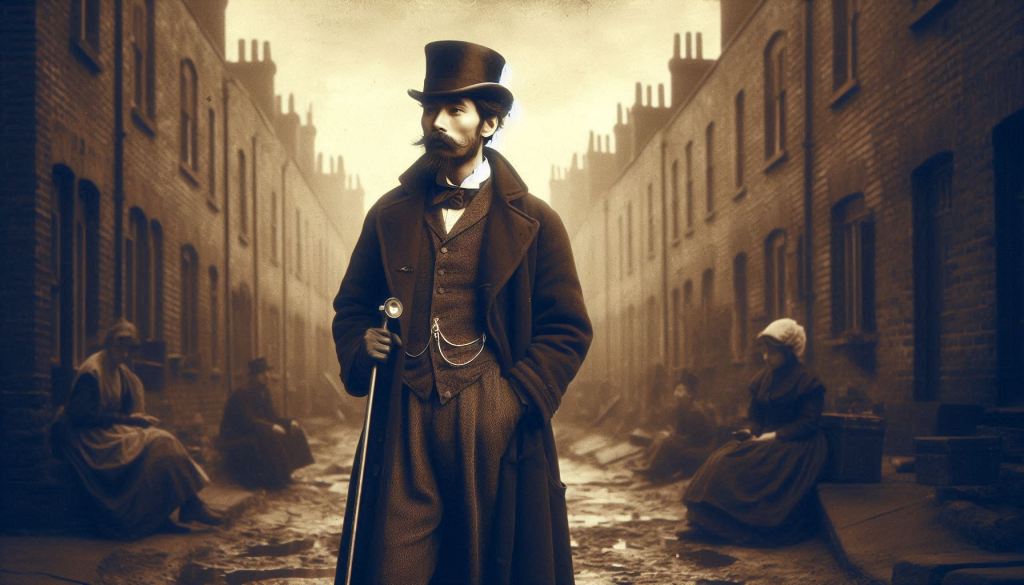
London, 1888
I. The Question
The woman’s voice cut through the fug of my consulting room, sharper than the scalpel I’d just sterilised. “Do you practice religion, Doctor?”
I paused, the instrument hovering above the spirit lamp. Mrs. Pembroke lay on the examination table, her rheumy eyes fixed on the cracked ceiling, fingers worrying at the rosary entwined in her shawl. The smell of carbolic soap and damp wool clung to the air.
“I practice medicine,” I said finally, nodding to my brass plaque on the wall—Dr. Edmund Whitcombe, MBBS. “That’s scripture enough for these streets.”
Outside, Whitechapel growled its usual chorus: costermongers hawking rotting fruit, the clatter of hansom wheels on cobbles, a drunk warbling The Unfortunate Rake. My surgery occupied the first floor of a tenement on Flower and Dean Street, its walls sweating with the breath of too many souls. I’d chosen it precisely for that reason—proximity to those who needed a physician with a strong stomach and few scruples about payment.
Mrs. Pembroke’s laugh rattled like a deathwatch beetle. “You’ll meet your Maker same as the rest of us. Best make peace before the cough takes you.” She gestured to the blood-flecked handkerchief in my waste bin, relic of my last patient.
I pressed the stethoscope to her chest. “Your heart’s racing. When did the palpitations start?”
“Same time I seen her again. Down by the soup kitchen.”
“Her?”
“The nun what vanished. Sister Agnes. Came back last Tuesday, bold as Lazarus.”
The diaphragm slipped on her sternum. I knew that name. Three months prior, St. Mary’s Shelter had closed when its directress disappeared midwinter. The East London Observer speculated she’d been another Ripper victim, though no body surfaced.
“You’re mistaken,” I said. “Sister Agnes is—”
“Alive.” She seized my wrist, nails biting flesh. “Saw her with me own eyes, tending to that Irish beggar what coughs up his guts near Petticoat Lane. She had the mark, clear as day.”
“What mark?”
Her thumb smeared a cross on my palm. “The stigmata, Doctor. Fresh as Christ’s own.”
II. The Wound
I didn’t believe her. Not until Thursday, when Tommy O’Shea stumbled into my surgery reeking of gin and gangrene.
“Leg’s gone queer,” he slurred, collapsing onto the oak examination table I’d salvaged from Bart’s Hospital. The limb in question was a horror: ulcers oozing greenish pus, toes blackened by frostbite. I reached for my bone saw.
“Leave that.”
The voice stopped me cold—low, melodic, with a hint of Donegal. A woman stood in the doorway, backlit by the stairwell’s gaslight. Her nun’s habit hung loose on a frame too thin for the winter of 1888, the wimple framing cheeks hollow enough to showcase jawbone. But it was her hands that arrested me.
They glowed.
Not metaphorically. A faint bioluminescence shimmered around her fingers, casting watery light on the floorboards. When she moved to touch Tommy’s forehead, I saw the wounds—jagged crescents in both palms, unbandaged and uninfected.
“Sister Agnes, I presume?” I snapped. “You’re three months late for your own requiem.”
Her smile held more shadows than my tenement. “We’ve all our resurrections, Doctor. May I?”
I gestured to the patient. What followed defied every medical text from Hippocrates to Lister. Her luminous hands passed over Tommy’s leg without contact. The ulcers closed like flowers at dusk. Colour flooded back into necrotic tissue. When she finished, even his whisky flush had faded to healthy pink.
Tommy gaped at his restored leg. “Saints alive—”
“Hush,” Sister Agnes murmured. “The price is silence.”
She turned to me, the light in her hands dimming. Up close, I noted the scar slicing her left brow—an old injury, poorly stitched. Her eyes were the precise grey of the Thames at dawn.
“You’re no nun,” I said.
“And you’re no believer. Yet here we are.”
III. The Diagnosis
We struck an uneasy pact. She’d help me treat the incurable; I’d ask no questions. Over the next fortnight, my surgery became ground for miracles even my atheist tongue couldn’t deny.
A docker’s daughter woke from typhoid coma.
A matchgirl’s phosphorus-rotted jaw regrew teeth.
Each healing left Sister Agnes paler, the light in her hands fainter. I found her one evening slumped in my armchair, a vial of laudanum slipping from her grip.
“You’re killing yourself,” I accused, checking her pulse—thready, arrhythmic.
Her lashes fluttered. “Transubstantiation requires sacrifice, Edmund.”
“Don’t.” I jerked back as if scalded. “We’re not friends.”
“Aren’t we?” She pressed her wounded palm to my cheek. Images exploded behind my eyes:
A girl in a Galway workhouse, stealing bread. A ship’s hold stinking of dysentery. A East End alley, a man’s hands at her throat. Light erupting from her blood.
I wrenched free, gasping. “What are you?”
“A reminder.” She stood, swaying. “That your science and my faith are scalpels from the same forge. Both cut. Both heal.”
IV. The Crisis
The riots began on December 12th.
News of the “Angel of Whitechapel” had spread through pubs and pawnshops. Now a mob crushed against my surgery doors—consumptives, syphilitics, mothers with scrofulous babes. They smashed windows, chanting her name like a Papist litany.
“You must stop,” I begged as she healed a bricklayer’s crushed hand. Her habit was sweat-soaked, the stigmata now bleeding freely.
“Would you?” she gasped. “If this power were yours?”
I had no answer. My own sins flickered behind my ribs—the sister I’d failed to save from cholera, the morphine I’d swallowed after her funeral.
At midnight, she collapsed mid-healing. I carried her to my lodgings, the mob’s torches painting the walls hell-red. Her breath soughed like sailcloth in a storm.
“Listen,” she whispered as I tried to stanch her palm-wounds. “The gift… it’s not divine. Caught it from a patient in ’79. Some new… disease…”
Ice pooled in my gut. “Contagious?”
Her laugh bubbled with blood. “Only to those who… who choose…”
The light in her hands flared one final time—a supernova in that grimy room—then winked out.
V. The Revelation
They found her body in the Thames two days later. No marks except the stigmata. I attended the inquest, signed the death certificate, and lied through my teeth.
That Sunday, I walked into St. Botolph’s despite myself. The vicar spoke of Lazarus. I watched light stream through stained glass, painting the flock in ruby and sapphire.
A child coughed near the font—the croup, by the sound. Without thinking, I reached for him.
My hands stayed stubbornly dark.
But later, as I mixed a tincture of ipecacuanha in my surgery, I realised Sister Agnes had been wrong about one thing.
Compassion needs no miracle. Only the will to act.
The vial glinted in my hand. Somewhere below, a beggar hawked the Pall Mall Gazette: “PLAGUE SAINT VANISHES!”, while a new mother sang Lavender’s Blue to her babe.
I added honey to the medicine. Sweetness helps the medicine go down.
The End
Bob Lynn | © 2025 Vox Meditantis. All rights reserved.

 Vox Meditantis
Leave a comment