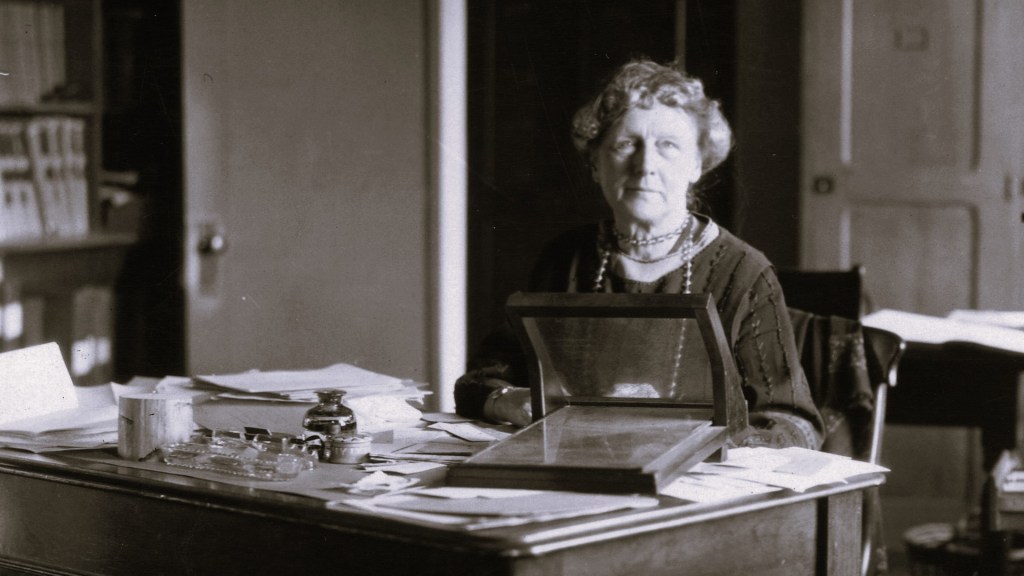
When Annie Jump Cannon classified her 350,000th star in the early 20th century, she had already revolutionised astronomy and created the system still used today to understand our universe. Yet this deaf woman from Delaware, who spent decades transforming stellar science whilst earning 50 cents an hour, remains largely unknown outside academic circles. Her story exposes the systematic marginalisation of women’s contributions to science—a deliberate erasure that robbed humanity of recognising one of its greatest astronomical minds.
A Foundation Built on Wonder
Annie Jump Cannon was born on 11th December 1863 in Dover, Delaware, to Wilson Lee Cannon, a shipbuilder and state senator, and Mary Elizabeth Jump. Her mother possessed an unusual characteristic for women of that era: a genuine passion for astronomy acquired during her studies at a Quaker finishing school near Philadelphia. Mary Jump didn’t merely tolerate her daughter’s curiosity—she actively nurtured it, opening the trapdoor to their roof so they could observe stars together in their makeshift observatory.
This maternal encouragement proved transformative. Using an old astronomy textbook, mother and daughter would identify constellations from their attic, laying the groundwork for what would become one of the most significant careers in astronomical history. Mary Jump also taught Annie household economics—skills that would later prove invaluable in organising complex research projects involving hundreds of thousands of stellar observations.
At the Wilmington Conference Academy, Cannon demonstrated exceptional mathematical ability. Her academic prowess earned her admission to Wellesley College in 1880, one of America’s premier institutions for women’s education. There, she studied physics and astronomy under Sarah Frances Whiting, one of the few women physicists in the United States. Cannon graduated as valedictorian in 1884, a remarkable achievement that should have launched her directly into scientific prominence.
Instead, she returned to Delaware and spent nearly a decade on photography and travel—a pattern that reveals the limited opportunities available to even the most brilliant women of her generation.
Entering Harvard’s Scientific Hierarchy
The death of her mother in 1894 marked a turning point. Cannon returned to Wellesley for graduate study, then enrolled at Radcliffe College in 1895 to access Harvard’s telescopes. In 1896, Edward Pickering hired her as an assistant at Harvard College Observatory for the princely sum of 50 cents per hour.
Cannon joined a group of women astronomers known as “Pickering’s Women”—a nickname that perfectly encapsulates the patronising attitude of the era. These women were hired to perform the “tedious” work of analysing photographic plates and calculating stellar positions. The observatory could employ women as unpaid volunteers or for a fraction of men’s salaries, and Pickering observed that women were actually more capable of the detailed work than many male scientists.
This arrangement reveals the cynical exploitation masquerading as opportunity. Harvard wouldn’t grant graduate degrees to women in physical sciences, yet it happily utilised their superior analytical skills whilst paying them pittances. The women’s contributions were systematically minimised—catalogues were named after financial sponsors or senior male astronomers, rarely crediting the women who performed the actual scientific work.
Revolutionary Science in Plain Sight
Cannon’s genius emerged through her approach to stellar classification. The existing alphabetical system, running from A to Q based on hydrogen line strength, proved inadequate for her purposes. Rather than accept these limitations, she combined elements from different classification models to create something entirely new.
Her breakthrough was recognising that stellar characteristics correlated with temperature rather than hydrogen line strength alone. She reorganised the classification into the sequence O, B, A, F, G, K, M—from hottest to coolest stars. This system, remembered by generations of astronomy students through the mnemonic “Oh Be A Fine Girl, Kiss Me,” became the universal standard.
The scale of Cannon’s work defies comprehension. Between 1912 and 1915 alone, she classified over 225,000 stars. Her optimum rate was three stars per minute, meaning she spent approximately 75,000 minutes of her life analysing stellar photographs. Each spectrum required individual observation through a magnifying loupe on glass photographic plates covered with thousands of stellar images.
Her work was published in the nine volumes of the Henry Draper Catalogue, covering 225,300 stars, later expanded to include over 400,000 stellar bodies. She also discovered five novae and 300 variable stars. This wasn’t merely data collection—it was fundamental science that reshaped humanity’s understanding of stellar evolution and cosmic structure.
The Disability Barrier
Cannon’s achievements become even more remarkable considering she was profoundly deaf. Sources vary regarding the exact cause, but scarlet fever around age 30 left her relying primarily on lip-reading. In an era when disability was viewed as disqualifying, she transformed what others saw as limitation into focused concentration.
Her deafness added another layer of marginalisation to her gender-based exclusion. Harvard’s resistance to recognising her contributions stemmed not only from sexism but also from ableist assumptions about disabled people’s capabilities. That she revolutionised astronomy whilst navigating both forms of discrimination speaks to extraordinary determination and intellectual brilliance.
The Long Fight for Recognition
For decades, Cannon worked in unofficial capacities with titles like “Assistant” and “Curator of Astronomical Photographs,” despite making contributions that earned worldwide recognition from male peers who described her as “the greatest living expert in this area of investigation”. Harvard’s policy against hiring women kept her in limbo for most of her career.
Only in 1938—three years before her death—did Harvard finally award her the official position of William Cranch Bond Astronomer. This belated recognition came after she had already classified more stars than any human in history and created the classification system still used today.
Her honours included becoming the first woman to receive a Doctor of Astronomy degree from Groningen University, the first woman to receive an honorary degree from Oxford University, and the first woman awarded the Henry Draper Medal from the National Academy of Sciences. She served as treasurer of the American Astronomical Society from 1912-1919, the only female officer until the 1950s.
Legacy and the Price of Erasure
Cannon used her 1931 Ellen Richards Prize money to establish the Annie Jump Cannon Award through the American Astronomical Society, supporting women astronomers’ research. The award continues today, a fitting tribute to someone who understood the barriers facing women in science.
Yet her story remains largely untold outside astronomical circles. This erasure carries profound consequences. When we fail to celebrate scientists like Cannon, we perpetuate the myth that scientific achievement belongs primarily to men. We rob young women of role models and society of understanding how discrimination wastes human potential.
The Moral Imperative of Remembrance
Annie Jump Cannon’s life exposes the devastating cost of systemic discrimination. Here was a woman whose intellectual gifts revolutionised our understanding of the cosmos, yet who spent decades fighting for basic recognition whilst earning subsistence wages. Her achievements came not because the system supported her, but despite its determined efforts to marginalise her contributions.
We cannot change the injustices Cannon faced, but we can ensure her legacy inspires future generations. Every young person studying astronomy should know that the stellar classification system they learn was created by a deaf woman working for 50 cents an hour. Every university claiming to support women in science should remember how Harvard treated its greatest female astronomer.
Cannon’s story demands more than historical acknowledgement—it requires contemporary action. Her memory challenges us to examine how current institutions perpetuate similar exclusions and to build systems that recognise brilliance regardless of gender, disability, or other characteristics that prompt discrimination.
When we look up at the stars tonight, we see them through Annie Jump Cannon’s eyes, classified by her system, understood through her revolutionary work. That legacy deserves celebration, protection, and continuation.
Bob Lynn | © 2025 Vox Meditantis. All rights reserved.

 Vox Meditantis
Leave a comment