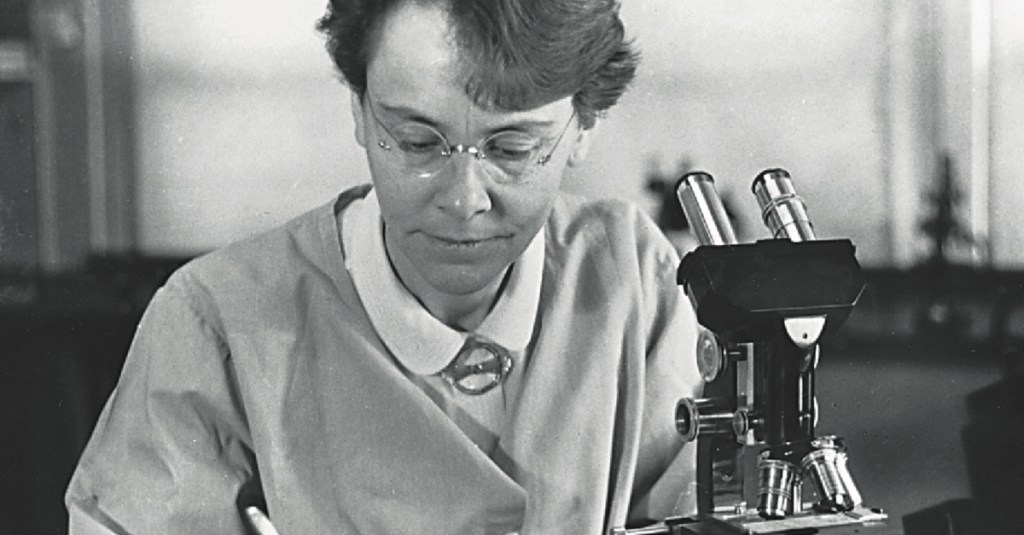
In the rigid hierarchies of mid-20th century science, where women were barely tolerated and revolutionary ideas met with institutional scorn, Barbara McClintock stood alone in a maize field, watching chromosomes dance. Her discovery of “jumping genes” would fundamentally reshape our understanding of genetics, yet for decades, the scientific establishment dismissed her work as impossible nonsense. This is the story of a brilliant woman whose ideas were too radical for her time, and how scientific prejudice nearly buried one of biology’s most important discoveries.
The Making of a Maverick
Barbara McClintock’s journey began in 1902, when such a career seemed almost inconceivable for women. Born in Hartford, Connecticut, she displayed an early independence that would serve her well in the hostile world of academic science. At Cornell University, women weren’t even permitted to major in genetics, yet McClintock became a driving force in maize cytogenetics through sheer determination and intellectual brilliance.
Her early work was nothing short of exceptional. In 1931, she and colleague Harriet Creighton published a landmark paper establishing that chromosomes formed the basis of genetics—work that would have guaranteed any male scientist immediate recognition. McClintock developed innovative techniques for visualising maize chromosomes and created the first genetic map for maize, linking physical traits to chromosomal regions. She demonstrated the crucial roles of telomeres and centromeres in genetic conservation, discoveries that alone should have secured her scientific immortality.
The scientific community recognised her early promise. She was elected to the National Academy of Sciences in 1944, becoming one of only a handful of women to receive this honour. Yet even as accolades mounted, the seeds of future conflict were being sown. McClintock’s work increasingly challenged fundamental assumptions about how genes operated—assumptions that would prove remarkably resistant to change.
The Discovery That Shocked Science
In 1944, whilst working at Cold Spring Harbor Laboratory, McClintock made an observation that would revolutionise biology—if anyone had been listening. Among her maize plants, she identified two genetic loci she named “Dissociator” (Ds) and “Activator” (Ac). These weren’t ordinary genes. They moved. They jumped from one chromosomal location to another, defying everything scientists thought they knew about genetic stability.
McClintock’s evidence was meticulous and overwhelming. She observed that these “controlling elements” could insert themselves into genes, disrupting their function, and then jump out again, restoring normal gene expression. The variegated corn kernels in her fields told a story of genetic regulation that was dynamic, responsive, and infinitely more complex than the static gene maps that dominated textbooks.
Her 1950 paper in the Proceedings of the National Academy of Sciences laid out years of experimental data supporting transposition. She described mutations that could switch genes on and off—a concept that contradicted the prevailing belief that mutations permanently inactivated genes. More provocatively still, she suggested that these mobile elements might be the genome’s way of responding to environmental stress, a notion that seemed almost heretical to scientists wedded to the idea of fixed genetic programs.
The Sound of Silence
When McClintock presented her findings at the 1951 Cold Spring Harbor Symposium, the response was telling: dead silence. This wasn’t the thoughtful quiet of scientists processing revolutionary ideas—it was the uncomfortable silence of a community confronting something it refused to accept.
The reaction that followed was predictably brutal. McClintock described it as “puzzlement, even hostility”. She recalled being “startled when I found they didn’t understand it; didn’t take it seriously”. The concept of jumping genes simply didn’t fit within the rigid framework of 1950s genetics. Decades of genetic mapping had convinced scientists that genes occupied fixed positions—the idea that they could relocate was inconceivable.
Here was the scientific establishment at its most conservative, clinging to familiar paradigms whilst rejecting evidence that challenged their worldview. McClintock’s work threatened the very foundations of genetic orthodoxy, and the response was to ignore rather than investigate. By 1953, worn down by constant dismissal, she stopped publishing her transposon research entirely.
Gender, Science, and the Matilda Effect
McClintock’s treatment exemplifies what scholars now call the “Matilda Effect”—the systematic underrecognition of women’s scientific contributions. Her experience with prominent geneticists François Jacob and Jacques Monod in 1961 illustrates this dynamic perfectly. When McClintock attempted to explain her controlling elements to these future Nobel laureates, they simply couldn’t grasp what she was describing.
Was this merely a case of molecular biologists failing to understand classical genetics? The evidence suggests something more insidious. McClintock’s approach embodied what feminist philosopher Evelyn Fox Keller termed “gender-neutral science”—a reverence for organisms and biological complexity that challenged the reductionist approaches favoured by male-dominated molecular biology.
The irony is savage. McClintock’s discoveries predated the molecular revolution that would eventually validate her work. Whilst male scientists received acclaim for describing the rigid central dogma of molecular biology, she was already documenting the dynamic, responsive nature of genomes that would only be widely accepted decades later. Her holistic understanding of biological systems was dismissed as old-fashioned, when in fact it was decades ahead of its time.
Vindication and Legacy
The molecular biology revolution of the 1960s and 1970s gradually revealed the truth McClintock had been proclaiming since the 1940s. Other scientists began discovering mobile elements in bacteria, confirming that transposition was a general biological phenomenon rather than a maize oddity. The mechanisms of genetic regulation she had described were found to operate across all life forms.
When McClintock finally received the Nobel Prize in 1983, she was the first woman to win unshared recognition in Physiology or Medicine. The citation acknowledged her discovery of mobile genetic elements, but this recognition came four decades after her initial findings. How many other revolutionary discoveries might have accelerated biological understanding if McClintock’s work hadn’t been dismissed for so long?
Today, we understand that transposable elements comprise nearly half the human genome. They play crucial roles in evolution, development, and disease. McClintock’s insights about stress-induced genomic reorganisation have proven prophetic, with implications for everything from cancer research to understanding adaptive evolution.
The Unfinished Revolution
McClintock’s story remains painfully relevant. Her treatment reveals how scientific institutions can systematically exclude revolutionary ideas, particularly when they challenge established paradigms or come from marginalised voices. The decades-long delay in accepting her discoveries represents a catastrophic failure of scientific peer review—one that likely set back biological understanding by a generation.
What makes this particularly galling is McClintock’s own response to ostracism. Rather than abandoning her research, she continued working in relative isolation, sustained by her conviction that “if you know you’re right, you don’t care”. Her resilience in the face of institutional hostility demonstrates not just personal courage, but a commitment to scientific truth that shames those who dismissed her.
The scientific community’s eventual embrace of McClintock’s discoveries cannot erase the years of neglect. Her story serves as a stark reminder that brilliant women in science continue to face barriers their male colleagues never encounter. Until we acknowledge and address these systemic inequities, how many other Barbara McClintocks remain silenced in laboratories around the world?
McClintock once said that every component of an organism is as much an organism as every other part. Perhaps it’s time the scientific community learned to view its own members with similar respect and recognition. Only then might we avoid repeating the shameful chapter in which one of biology’s greatest discoveries was nearly lost to prejudice and institutional blindness.
Bob Lynn / 24-May-2025

 Vox Meditantis
Leave a comment